The Los Angeles Superior Court serves over nine million people, employs over 550 judges and commissioners, and is the largest trial court in the United States. The Central District of California serves over 19 million people in Southern and Central California, making it the most populous federal judicial district in the United States.
Despite having the distinction of being the largest courts in their respective systems, practice in these two courts is very different. Some of those differences are defined by rules of court, some by culture, and some by necessity.
State court
Judges serving in most large trial courts, including all of the Southern California state courts, are specialists. The courts are divided into practice areas: civil, criminal, family, probate, juvenile, mental health, traffic and the like.
Trial court judges are assigned cases in accordance with the rules governing case assignments in the county in which they sit. For example, in Los Angeles County, case assignments are governed by LASC Local Rules 3.2 and 3.3. With limited exceptions, trial courts adopt case management rules for all cases pursuant to the California Rules of Court.
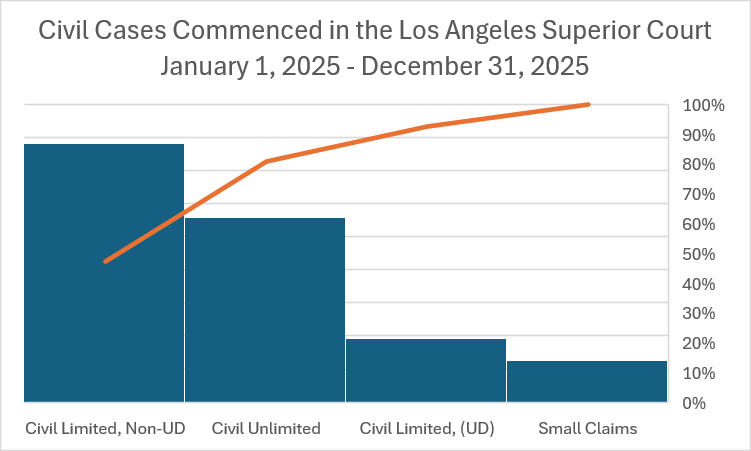
In the civil division, cases are further differentiated and assigned by amount in controversy: Civil Unlimited, which are matters where the dollar amount or value of the property in dispute exceeds $35,000; Civil Limited, Non-Unlawful Detainer, which are matters where the dollar amount in dispute or value of the property does not exceed $35,000; Civil Limited, Unlawful Detainer, which are civil cases brought by a landlord who is suing a tenant to obtain a court order giving the landlord the right to regain possession of the property from the tenant; and Small Claims, which are matters where the dollar amount in dispute or value of the property does not exceed $12,500 in Small Claims Court for individual plaintiffs or up to $6,250 for entity plaintiffs. Civil Unlimited matters include actions that require exceptional judicial management to avoid placing unnecessary burdens on the Court or the litigants as defined by California Rules of Court Rule 3.400.
Civil caseloads are heavy and increasing. In 2025, 330,801 new civil cases were filed in the Los Angeles Superior Court.
Source: Superior Court of LA County, https://www.lacourt.ca.gov/pages/lp/research-and-statistics/cp/court-statistics (last visited September 22, 2026).
When litigating in state court, practitioners should follow the Code of Civil Procedure (CCP), the California Rules of Court (CRC), and all applicable local rules. Although the days of “local-local” rules have passed, it is advisable to check for standing orders or “courtroom information.” While these edicts should not conflict with the CCP, CRC, or local rules, they may include judicial preferences or additional information to assist attorneys and parties with the presentation of their cases.
Case management is a challenge. Not only are judges in civil assignments tasked with managing the process to get the case “at issue,” but they are also responsible for managing their caseloads so cases progress efficiently through litigation and ultimately to resolution. Given the volume of civil filings and the challenges presented by limited judicial resources, this is not an easy task. But the parties deserve no less.
Federal court
Unlike state court judges, all of the District and Magistrate Judges in the Central District of California have different procedures and schedules. These procedures and schedules can be accessed here: https://apps.cacd.uscourts.gov/Jps/?OpenDocument=
Most judges update their procedures periodically, so it is important that attorneys and other litigants check these procedures regularly.
Federal courts hear criminal, civil, and bankruptcy cases. Unlike state trial court judges, federal judges are generalists. While the composition of the docket is more diverse, federal courts are courts of specific subject matter jurisdiction. Federal courts “have an independent obligation to ensure that they do not exceed the scope of their jurisdiction, and therefore they must raise and decide jurisdictional questions, regardless of whether they are raised by the parties.” (Henderson ex rel. Henderson v. Shinseki (2011) 562 U.S. 428, 434, 131 S. Ct. 1197, 179 L. Ed. 2d 159; Allstate Ins. Co. v. Hughes (9th Cir. 2004) 358 F.3d 1089, 1093.)
Subject matter jurisdiction
Federal courts have jurisdiction to adjudicate only those cases that the Constitution and Congress authorize them to adjudicate: those involving diversity of citizenship or a federal question, or to which the U.S. is a party. (Kokkonen v. Guardian Life Ins. Co. of America (1994) 511 U.S .375, 377; Kelly v. Wengler (9th Cir. 2016) 822 F.3d 1085, 1094.)
The parties to a federal civil action cannot create subject matter jurisdiction where jurisdiction does not exist. (Bender v. Williamsport Area Sch. Dist. (1986) 475 U.S. 534, 541, 106 S. Ct. 1326, 89 L. Ed. 2d 501; Evergreen Square of Cudahy v. Wisconsin Hous. & Econ. Dev. Auth. (7th Cir. 2015) 776 F.3d 463, 465.)
In fiscal year 2025, Ninth Circuit district courts reported 72,629 filings, or 19.6% of the total district court filings nationwide, ranking first in the nation. The Ninth Circuit ranked first in total civil filings and ranked second in total criminal filings nationwide in FY 2025. (United States Courts For The Ninth Circuit 2025 Annual Report, https://www.ce9.uscourts.gov/annual-reports/.)
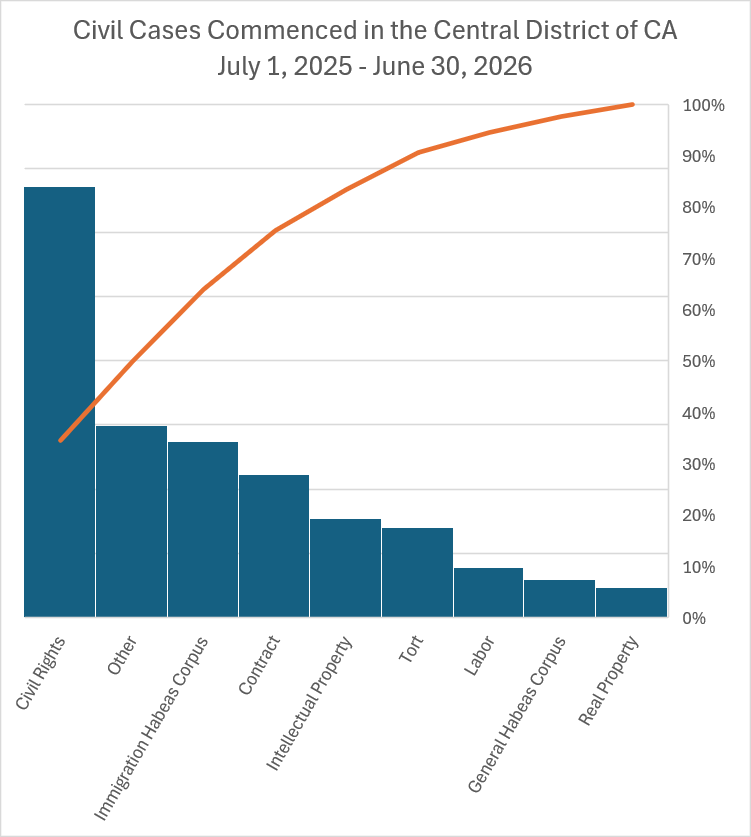
Civil caseloads are heavy and increasing. Most of these cases are civil rights and immigration habeas corpus cases. For the period July 1, 2025 – June 30, 2026, 21,645 new civil cases were filed in the Central District of California.
Source: United States Courts, https://www.uscourts.gov/data-news/data-tables/2026/06/30/statistical-tables-federal-judiciary/c-3 (last visited September 22, 2026).
In addition to the case management challenges faced in state court, federal courts are responsible for adjudicating civil cases while balancing constitutional mandates in criminal cases and appellate responsibilities in bankruptcy appeals.
Federal question jurisdiction
Article III, section 2 extends the federal judicial power to: “… Cases, in Law and Equity, arising under this Constitution, the Laws of the United States, and Treaties made, or which shall be made, under their Authority … and Controversies to which the United States shall be a party …”
Examples of federal statutes that confer jurisdiction on federal courts to hear specific types of controversies include patent and copyright laws, commerce and antitrust laws, securities laws, and postal laws.
Federal courts also have federal question jurisdiction any action commenced by the United States, or any agency or officer authorized to sue on its behalf. (28 U.S.C. § 1345.) Where the United States consents to be sued, federal courts have subject matter jurisdiction to hear those cases. (28 U.S.C. §§ 1346(a),(d) & 1491; Mills v. United States (9th Cir. 2014) 742 F.3d 400, 405.) Finally, the Foreign Sovereign Immunities Act (FSIA) gives district courts original jurisdiction over nonjury civil actions against a foreign state in which the foreign state is not entitled to immunity. (28 U.S.C. §§ 1330(a), 1605-1607; see also 28 USC § 1441(d).)
Diversity jurisdiction
Federal courts have original jurisdiction of all civil actions where the matter in controversy exceeds the sum or value of $75,000, exclusive of interests and costs, and is between: citizens of different States; citizens of a State and citizens or subjects of a foreign state, except that the district courts shall not have original jurisdiction of an action between citizens of a State and citizens or subjects of a foreign state who are lawfully admitted for permanent residence in the United States and are domiciled in the same State; citizens of different States and in which citizens or subjects of a foreign state are additional parties; and a foreign state, as plaintiff, and citizens of a State or of different States. (28 U.S.C. § 1332(a).)
Removal jurisdiction
Federal courts may also have jurisdiction over cases originally filed in state court and removed to federal court. Any civil action filed in state court is removable if it might have been brought originally in federal court. (28 U.S.C. § 1441(a).) Federal courts consider whether either diversity or federal question jurisdiction can be established. (Caterpillar Inc. v. Williams (1987) 482 U.S. 386, 392, 107 S. Ct. 2425, 96 L. Ed. 2d 318.)
About 25% of the cases assigned to my docket were removed from state to federal court. They consist mostly of employment, breach of contract, personal injury, product liability, fraud, breach of contract, and insurance cases. Because federal courts have an independent obligation to ensure that they do not exceed the scope of their jurisdiction, federal judges closely scrutinize whether they have jurisdiction over cases coming to federal court in this way.
Class Action Fairness Act
The Class Action Fairness Act (CAFA) provides federal courts with original jurisdiction to hear a class action if the class has more than 100 members, the parties are minimally diverse, and the matter in controversy exceeds $5 million in sum or value. (28 U.S.C.A. § 1332(d)(2), (d)(5)(B).)
Class-action litigation
Class actions are governed by Rule 23 of the Federal Rules of Civil Procedure. There are several prerequisites for maintaining a class action: (1) the class must be so large that individual suits would be impracticable, (2) there must be legal or factual questions common to the class, (3) the claims or defenses of the representative parties must be typical of those of the class, and (4) the representative parties must adequately protect the interests of the class. (Fed. R. Civ. P. 23.)
Unlike state court, class actions in federal court are assigned like any other civil case and the judge has case management flexibility.
In state court, the California Rules of Court require that the trial judge make a “complex” determination in order to unlock certain case management tools. Class actions are usually designated as complex and assigned to a judge assigned to handle complex matters. A case may be deemed complex if it “requires exceptional judicial management to avoid placing unnecessary burdens on the court or the litigants and to expedite the case, keep costs reasonable, and promote effective decision making by the court, the parties, and counsel.” (CA ST CIVIL RULES Rule 3.400.)
Mass-tort litigation
Mass torts litigation “emerges when an event or series of related events injure a large number of people or damage their property. A mass tort is defined by both the nature and number of claims; the claims must arise out of an identifiable event or product, affecting a very large number of people and causing a large number of lawsuits asserting personal injury or property damage to be filed.” (Introduction, Ann. Manual Complex Lit. § 22.1 (4th ed.).)
The volume of litigation generated by mass tort litigation necessitates special judicial case management. Because some mass tort cases lend themselves to group litigation and others require individualized adjudication, a one-size-fits-all approach to case management is not ideal.
Like class actions, mass tort cases in federal court are assigned like any other civil case and the judge has case management flexibility. In state court, the trial judge makes a complex determination in order to unlock the case management tools needed to efficiently adjudicate the case.
The challenge presented by these cases in federal court stems from the fact that state substantive law usually governs mass tort cases. This makes multistate aggregations of cases even more complex. Another complicating issue comes up in cases where it is necessary to allocate responsibility among many defendants and/or insurance companies. This issue makes the determination of whether or how to aggregate claims for pretrial management or final resolution more difficult in both state and federal courts.
Coordinated proceedings
State and federal courts each have mechanisms for determining whether or how to aggregate claims for pretrial management or final resolution.
State court: Judicial council coordinated proceedings
Coordination allows two or more civil actions that share common questions of fact or law and that are pending in different counties to be joined in one court in the interest of justice. (Code Civ. Proc., § 404.1.)
When noncomplex actions are sought to be coordinated, a motion is made directly to the court in which one of the actions already is pending. “When complex actions are sought to be coordinated, a petition to coordinate the actions is submitted to . . . the Chief Justice, who assigns a motion judge to decide the merits of the petition. If coordination is granted by the motion judge, the Chief Justice assigns a trial judge. The coordination attorney at the Judicial Council administers petitions to coordinate complex actions, at the direction of the Chief Justice.” (https://courts.ca.gov/courts/superior-courts/civil-case-coordination.)
A petition for coordination may be submitted by any of the following: a presiding judge of any court in which one of the included actions is pending; all plaintiffs or all defendants to one of the included actions; or any party to one of the actions, after obtaining an order granting permission from the presiding judge. (Code Civ. Proc., § 404, CA ST CIVIL RULES Rule 3.520(b).)
The 10 Los Angeles Superior Court’s Complex Civil Litigation specialty courts have been designated to handle Judicial Council Coordinated Proceedings assigned to Los Angeles.
More information and forms can be accessed at: https://www.lacourt.ca.gov/pages/lp/civil/tp/civil-case-types-and-specialty-courtrooms/cp/complex-civil-litigation.
Federal court: Multidistrict Litigation
In federal court, case management is national.
The United States Judicial Panel on Multidistrict Litigation (“MDL Panel”) was created by an Act of Congress in 1968 and is tasked with (1) determining whether civil actions pending in different federal districts involve one or more common questions of fact such that the actions should be transferred to one federal district for coordinated or consolidated pretrial proceedings; and (2) selecting the judge or judges and court assigned to conduct such proceedings. (See 28 U.S.C. §1407.)
The MDL Panel consists of seven sitting federal judges, who are appointed to serve on the Panel by the Chief Justice of the United States. As proscribed by statute, no two Panel members may be from the same federal judicial circuit. (Ibid.) The current Chair of the Panel is Judge Karen K. Caldwell, who sits in the Eastern District of Kentucky. The remaining Panel members, in order of appointment to the Panel, are Matthew F. Kennelly (N.D. Illinois), David C. Norton (D. South Carolina), Dale A. Kimball (D. Utah), Madeline Cox Arleo (D. New Jersey), M. Casey Rodgers (N.D. Florida), and Richard Seeborg (N.D. California).
The work of the MDL Panel is aimed at preserving judicial and litigation resources. Coordinating cases avoids duplication of discovery, prevents inconsistent pretrial rulings, and conserves the resources of the parties, their counsel and the judiciary.
Cases coordinated in Multi District Litigation matters (“MDLs”) are not terminated in the transferee district; rather they are remanded to their originating transferor districts by the Panel at or before the conclusion of centralized pretrial proceedings.
The MDL Panel has created over 1,800 MDLs involving over 1.3 million cases. MDL case types include mass torts; securities fraud; mass torts; single accidents such as airplane crashes, train wrecks and hotel fires; products liability; employment practices; marketing and sales practices; patent validity and infringement; antitrust price fixing; and data security breaches. And with the rapid evolution of technology-related litigation, the list is sure to grow.
The composition of cases encompassed in an MDL vary. Some consist exclusively of individual actions. Some consist of individual and class actions. And the size of the MDL can vary widely – some consist of a few cases while others may consist of more than a thousand.
More information and forms can be accessed at: https://www.jpml.uscourts.gov/
Conclusion
The long and the short of it: There is substantial overlap in the type and complexity of civil litigation between state and federal courts. But the way civil cases are litigated in each forum varies greatly. State court features more standardization and significantly more judicial officers. Federal court features fewer judicial officers who handle all case types authorized by statute and the Constitution. It is incumbent upon practitioners to know the rules and litigate accordingly.
Hon. Michelle Williams Court is a United States District Judge in the Central District of California and a former Supervising Judge of Civil Division of the Los Angeles Superior Court.