
Mediating federal cases in the Central District of California
A blueprint for utilizing the Central District’s mediation program
The federal civil trial courts, especially in the Central District of California, have heavy caseload challenges. To alleviate the pressure of these cases, the Central District has a mediation program for civil cases similar to the Los Angeles County Superior Court’s Mediation Volunteer Panel (MVP) program.
Central District’s jurisdiction and caseload statistics
The Central District of California covers a vast geographic swath from San Luis Obispo County to Riverside County with three divisions: Western, Eastern, and Southern. The Western division covers the following counties: San Luis Obispo, Santa Barbara, Ventura, and Los Angeles. The Eastern division covers San Bernardino and Riverside counties, and the Southern division covers Orange County.
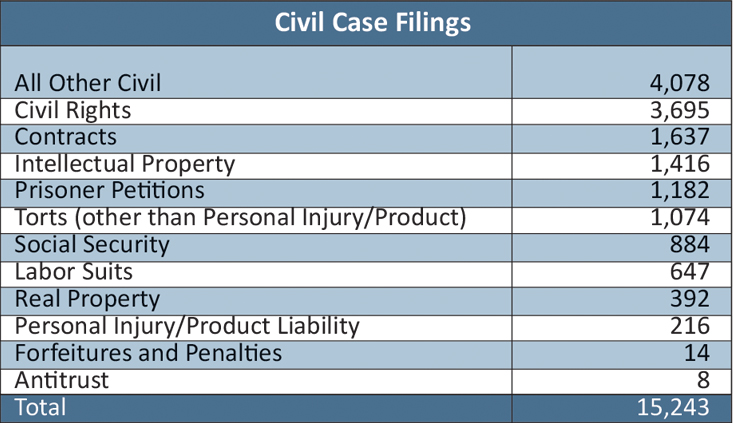
The latest available statistics from the Annual Report of Caseload Statistics for fiscal year (FY) 2023 (October 1, 2022, through September 30, 2023) show that the number of civil case filings was 15,243, up 11.5% compared to FY 2022. The number of pending cases at 10,688 was up 3.9% over FY 2022. The following chart from the FY 2023 report shows the breakdown of the categories of civil cases:(Source: https://www.cacd.uscourts.gov/sites/default/files/documents/ CACD_FY2023_Annual_Report)
Settlement conferences and mediations
The district tries to lessen the caseload by resolving cases through settlement conferences and mediation. Many judges and magistrates participate in settlement conferences. However, these conferences are not enough to reduce the caseload. Panel and private mediations have been added to the district’s Alternative Dispute Resolution (ADR) programs.
The Central District’s ADR program
The district’s ADR program began in 2011 under General Order 11-10 and Local Rule 16-15. Under the rules, the district provides three ADR options: (1) settlement conferences with judicial officers, (2) mediation through the court’s mediation panel, or (3) private mediation. As mentioned, some cases are resolved through settlement conferences with judicial officers participating in the program. The remaining cases are referred to the court’s mediation panel or private mediation. (Civil Local Rule 16-15.4; General Order 11-10). Unless the trial judge exempts, the parties in every civil case must participate in one of the three ADR options. (L.R. 16-15.1.)
Exempt cases
The following types of cases are exempt from the ADR programs (General Order 11-10):
(a) habeas corpus and extraordinary writs;
(b) immigration and naturalization;
(c) prisoner civil rights;
(d) Social Security; and
(e) petitions to enforce IRS summonses.
The Mediation Panel
The district has established a roster of skilled volunteer mediators, referred to as the Mediation Panel, whose members provide pro bono mediations for district court litigants. An individual interested in serving on the Mediation Panel as a volunteer mediator must apply to join the panel by completing the Mediation Panel Application Form (Form ADR-19), available at http://www.cacd.uscourts.gov/court-procedures/forms/ADR%20Forms. Applications are accepted every year between January 1 and March 31. Completed application forms must be returned by email to This email address is being protected from spambots. You need JavaScript enabled to view it. and must be received on or before March 31 to be considered for appointment to the Panel for that calendar year. An applicant will be considered for appointment to the panel if the applicant:
(a) Has been a United States appellate, district, magistrate, or bankruptcy judge, or a California judicial officer; or
(b) Is a current member in good standing of the bar of the United States District Court, Central District of California, with
- At least 10 years of legal practice experience,
- Substantial experience with or knowledge of civil litigation in federal court, and
- Significant expertise in one or more of the 21 types of civil cases handled in the district.
The court will consider only applicants who have already completed a training course or courses in mediation totaling at least 32 hours of MCLE credit or who demonstrate concrete plans to attend such training within the calendar year in which the application is submitted.
Eligible applicants are appointed to two-year terms by the court. A panel member is expected to mediate at least two cases per appointment term and provide three hours of pro bono services for each case. After that, with the parties’ agreement, they can charge their regular hourly rates.
Currently, the Mediation Panel has over 200 dedicated and skilled volunteer mediators. The list of panel mediators is available online on the court’s website at: https://www.cacd.uscourts.gov/attorneys/adr/list-panel- mediators. Civil litigants ordered to mediation through the Mediation Panel can review the list online and select a mediator from the panel.
Mediation using the Mediation Panel
Except for cases exempted (see above) and cases involving an unrepresented party, all civil cases assigned to judges participating in the court-directed ADR Program are presumptively referred to the Mediation Panel or a private dispute resolution process.
Rule 26(f) of the Federal Rules of Civil Procedure and Civil Local Rule 26-1 require that the parties meet and confer as soon as possible regarding a discovery plan, disclose relevant information, and, among other tasks, consider possibilities for prompt settlement or resolution of the case. As part of this conference, unless ordered otherwise by the court, the parties must also discuss whether their case is suitable for mediation with a neutral selected from the Mediation Panel or private mediation and the timing of the mediation. After reporting their election of the ADR method to the court, the assigned judge will issue an order/referral to the ADR program.
Selection of mediator
After being ordered to mediate using the Mediation Panel, the parties can select a mediator from the list of mediators on the panel. If the parties cannot agree on a mediator, they may ask the ADR program director to assign one from the panel list. After either the parties or the program director selects a mediator, the ADR Program must file and serve a “Notice of Assignment of Mediator” on the parties and the mediator.
Within 30 days of the Notice of Assignment of Mediator, the mediator must contact the parties to schedule a mediation session. The contact method may be a brief joint telephone conference or in writing at the mediator’s discretion. Similar to any pre-mediation communication with counsel, during the communication, the mediator may discuss the nature of the case, requirements for a mediation brief, the necessary parties to attend the mediation, the date of the mediation, whether or not the parties expect the mediation to last beyond three hours, arrangement for payment of the mediator’s market rate fees beyond the initial three hours, and any other procedural matters that increase the chances of resolution at the mediation.
Date and location of mediation
Within 35 days of the “Notice of Assignment of Mediator,” the mediator must file a “Notice of Mediation” to advise the ADR program of the scheduled mediation date. Every effort must be made to schedule the mediation as soon as possible to minimize the expense of litigation. If, for any reason, the mediator is unable, within 35 days of the “Notice of Assignment,” to set a mediation date, the mediator shall notify the ADR program director that a mediation could not be scheduled.
The mediation must be completed within the time frame ordered by the assigned judge. If no completion date has been ordered, the mediation must be completed no later than 45 days before the Final Pretrial Conference. (Civil L.R. 16-15.2.)
The court will provide suitable space for the mediation if a request is made to the ADR program director before the mediation. Typically, a couple of conference rooms in the court’s facilities are provided to the parties and the mediator to conduct the mediation if in-person mediation is desired. The ADR office of the court in downtown Los Angeles has dedicated space with two conference rooms for the parties to use. In recent years, with the advent of online platforms such as Zoom and Microsoft Teams, many mediators conduct these mediations online, reducing travel time and expenses for litigants.
Attendance requirement at the mediation
Each party shall appear at the mediation in person or by a representative with final authority to settle the case. In the case of lawsuits brought against the United States or any of its agencies as a party, the attendance of an attorney charged with responsibility for the conduct of the case (typically an assistant United States attorney) and who has final settlement authority as provided by his or her superiors is acceptable. A corporation or other non-governmental entity satisfies the attendance requirement if represented by a person who has final settlement authority and knows the facts of the case. Representatives of insurers with decision-making authority must attend mediation sessions unless the mediator excuses personal attendance.
At the mediator’s discretion, and only with the mediator’s express authorization, parties residing outside the Central District may have a representative with final settlement authority available by telephone during the entire proceeding in place of personal appearance. (Civil L.R. 16-15.5(b).) Online platforms dramatically reduce the chances of unavailability due to distance.
It is important to note that each party shall be represented at the mediation by the attorney who is expected to try the case unless excused for good cause by the mediator. (Civil L.R. 16-15.5(c).)
Confidentiality
Section 9 of General Order 11-10 requires that the court, the mediator, all counsel, parties, and any other persons attending the mediation treat the following as “confidential information”:
The contents of any written mediation statement;
Any documents prepared for, during, or pursuant to the mediation;
Anything that happened or was said relating to the subject matter of the case in mediation;
Any position taken; and
Any view of the case’s merits expressed by any participant in connection with any mediation.
“Confidential information” as defined above shall not be disclosed to anyone not involved in the litigation, disclosed to the assigned judge, or used for any purpose, including impeachment, in any pending or future proceeding in the court or any other forum.
Exceptions to confidentiality
The Confidentiality rule stated above does not prohibit:
(a) Disclosures as may be stipulated by all parties and the mediator;
(b) Disclosures as may be stipulated by all parties, without the consent of the mediator, for use in a subsequent confidential ADR or settlement proceeding;
(c) A report to or an inquiry by the ADR judge regarding a possible violation of policies and procedures governing the ADR Program by the parties or the mediator;
(d) The mediator from discussing the mediation process with the ADR Program staff, who shall maintain the confidentiality of the process;
(e) Any participant or the mediator from responding to an appropriate request for information duly made by persons authorized by the Court to monitor or evaluate the Court’s ADR program;
(f) Disclosures as are required by General Order 11-10, related ADR forms, and as otherwise required by law; or
(g) In an action or proceeding to enforce a settlement, the admission of a written settlement agreement or a settlement placed on the record, reached as a result of mediation.
Confidentiality agreements
The mediator may ask the parties and all people attending the mediation to sign a confidentiality agreement on a form provided by the court. However, the confidentiality provisions of Section 9 of General Order 11-10 apply regardless of whether a confidentiality agreement is signed.
Scope of confidentiality
Nothing stated in the General Order regarding confidentiality is intended to limit any applicable privilege or rule of evidence designed to protect mediation confidentiality, and any such broader protection shall control if applicable. (Civil L.R. 16-15.8.)
Mediation forms
All forms required to arrange and conduct the mediation and report to the court are available on the court’s website at: https://www.cacd.uscourts.gov/court-procedures/forms/ADR%20Forms. The district prefers that the parties use the court’s forms instead of creating and filing their own.
Impact of the Central District’s mediation program and settlement statistics
Official data regarding cases and settlements is only available for the period ending December 31, 2023. In the 2023 calendar year, at least 3,123 cases were referred to one of the three ADR options provided in Local Rule 16-15.4. Of these, more cases were referred to the Mediation Panel than to the other available choices. In 2023, the Mediation Panel was composed of 206 panel members. Panel mediators conducted at least 539 mediation sessions in the calendar year 2023. Of these, 214 sessions were reported to have resulted in a settlement or partial settlement, for a settlement rate of 40 percent. During the same period, magistrate judges held 264 settlement conferences in 224 cases, of which 88 resulted in a settlement for a 39 percent settlement rate.
More recent, unofficial data shows that in the calendar year 2024, the settlement rate by panel mediators remained close to that of 2023. Of the reported 499 cases referred to the panel mediators, 197 were settled, and 20 were partially settled.
Conclusion
Like the state superior courts, the Central District of California struggles with heavy caseloads. Settlement programs like the mediation program are essential to lessen caseloads and open trial courts for cases that deserve to be tried. So, next time you have a case in the central district, try to take advantage of the mediation program. Better yet, apply for inclusion in the mediation panel and help the court reduce its caseload.
Steve Sepassi

Steve Sepassi is a mediator with ADR Services, Inc., in Los Angeles, where he mediates personal injury, real estate, school liability, landlord-tenant, and commercial disputes matters. A graduate of Southwestern University School of Law (Class of ’95), Steve was a litigator for over 27 years, representing plaintiffs and defendants, including insured defendants, in a broad range of litigation matters before becoming a full-time mediator. He can be reached at ssepassi@adrservices.com.
Copyright ©
2026
by the author.
For reprint permission, contact the publisher: Advocate Magazine