
You took the deposition, but can you use it at trial?
How to set up your depositions – from notice to questioning – so they work when it counts
Effective use of deposition testimony at trial begins long before the first question is ever asked. The attorneys who are best prepared to deploy depositions at trial are those who thought about trial while they were still in the discovery phase. That means understanding the applicable code sections early, ensuring your deposition notices contain the required statutory language, and knowing before you walk into the room whether the testimony you are about to take is something you will realistically be able to use in trial.
Pre-deposition checklist: Set yourself up for trial
- Before you serve your first deposition notice, run through the following checklist.
- Review all discovery responses and documents to identify every place the witness’s name appears.
- Seek key documents early so you are prepared to ask the right questions. Do not wait until serving the deposition notice to request them.
- Ensure your notice expressly states your intent to record by video technology and reserves the right to use the deposition at trial pursuant to Code of Civil Procedure section (“CCP §”) 2025.220.
- Determine whether the witness is someone whose testimony you may be able to play at trial. (See CCP § 2025.620.) If so, structure your outline around the questions you need for trial.
- Identify whether the witness is one you are permitted to lead – adverse party, officer, director, managing agent, employee, or hostile witness – and know this before you walk in. (Evid. Code, §§ 776, 767.)
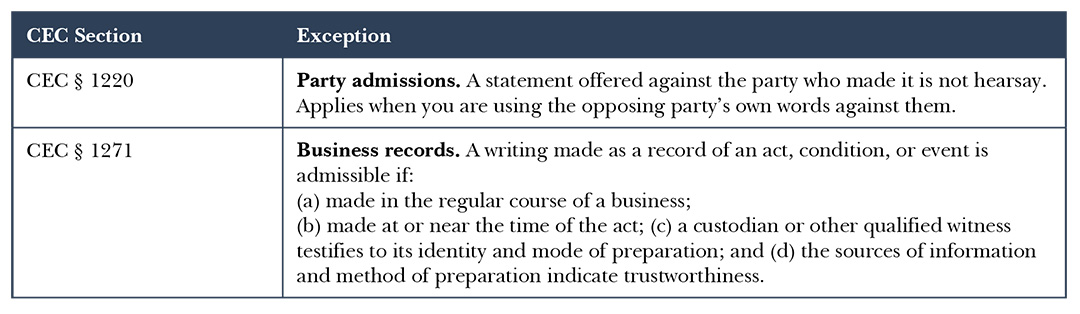
- Ascertain whether the witness drafted any key documents. If so, lay the foundation for the document and be sure to address any hearsay exceptions – such as the Business Records Exception. (Evid. Code, § 1271).
- Confirm whether the witness resides out of state. If so, treat this deposition as your actual trial examination. You will not get another opportunity.
- Decide whether to videotape the deposition. If there is any realistic chance you will use this testimony at trial, videotape it. Best practice is to videotape all depositions, budget permitting.
- Draft a detailed outline, but don’t be married to it. Think about what happens if the witness testifies to the opposite of what you expect, and have a plan for that scenario.
Think about the questions you want at trial first and work backwards. Structure your outline around the key soundbites and admissions you need, not just the facts you want to cover.
Get the notice right
Any witness whose testimony you realistically anticipate playing at trial must be videotaped. In cases with serious injuries, you should videotape all depositions.
The right to use a video deposition at trial depends entirely on whether your deposition notice included the proper statutory language. There are two distinct notice requirements under CCP § 2025.220:
First, any deposition notice must disclose the noticing party’s intent to record testimony by audio or video technology. (CCP § 2025.220(a)(5).) Second, when the deponent is a treating or consulting physician, or any expert witness, the notice must also state the party’s intent to reserve the right to use at trial a video recording of that testimony. (CCP § 2025.220(a)(6).)
Make these provisions part of your standard deposition notice template so you do not inadvertently forfeit this right. If the other side has noticed a deposition of your treating physicians or expert witnesses and you think you may want to use the video at trial, cross-notice the deposition and include both required provisions.
When can you use a deposition at trial?
Code of Civil Procedure section 2025.620 governs the use of depositions at trial and provides several independent bases for admission. Understanding these categories is essential.
Adverse party and affiliated witnesses
Under CCP § 2025.620(b), any party may use for any purpose the deposition of a party to the action, or of anyone who at the time of taking the deposition was an officer, director, managing agent, employee, agent, or PMK designee under CCP § 2025.230 of a party. Availability is not a prerequisite. This provision is particularly powerful in multi-defendant cases. Settling with one defendant does not eliminate your ability to use the deposition testimony of that party’s affiliated witnesses against the remaining defendants. It is not a valid objection that the deponent is available to testify, has already testified, or will testify at trial.
Unavailable witnesses
Under CCP § 2025.620(c)(1), a deposition may be used where the deponent resides more than 150 miles from the place of trial, or where the deponent is absent and the court is unable to compel attendance by process. Further, California courts cannot compel non-resident witnesses to appear at trial.
Impeachment
Under CCP § 2025.620(a), any party may use a deposition to contradict or impeach the testimony of the deponent as a witness, or for any other purpose permitted by the Evidence Code.
Exceptional circumstances
Code of Civil Procedure section 2025.620(c)(3) also provides a catchall provision permitting the use of a deposition where the court finds exceptional circumstances make it desirable in the interests of justice and with due regard to the importance of live testimony.
Expert-witness depositions:
Special rules
Expert-witness depositions carry special rules. Under CCP § 2025.620(d), any party may use a video recording of an expert’s deposition testimony at trial – even if the expert is available to testify, will testify, or has already testified – provided that (1) the deposition notice reserved the right to use the deposition at trial pursuant to CCP § 2025.220, and (2) the party has complied with CCP § 2025.340(m). It is crucial that you give proper notice, in the terms of the deposition notice itself as well as filing your intent to use videotaped deposition testimony at trial.
This provision is not limited to situations where your own expert is unavailable. It means you can strategically deploy critical admissions from a defense expert in your opening statement, during your case-in-chief, and during the cross-examination of other witnesses, regardless of whether that expert ultimately testifies.
Out-of-state witnesses: Treat the deposition like trial
When deposing an out-of-state witness, videotaping the deposition is a must, and here is the reason why: California courts cannot compel a non-resident to appear at trial. (See Toyota Motor Corp. v. Superior Court (2011) 197 Cal.App.4th 1107; Target National Bank v. Rocha (2013) 216 Cal.App.4th 9; Amoco Chemical Co. v. Certain Underwriters at Lloyd’s of London (1995) 34 Cal.App.4th 554, 559.)
Under CCP § 2025.620(c)(1), deposition testimony may be used at trial where:
The deponent resides more than 150 miles from the place of trial; or
The deponent is absent, and the court is unable to compel attendance by process.
Your deposition is your one and only opportunity to examine an out-of-state witness. This means your entire trial examination, and every question you would want to ask on the stand must be covered at the deposition. It also means that if the out-of-state witness lays the foundation for a key document or record, that foundation must be established at the deposition. You cannot go back. If you cannot later compel the witness to appear, the deposition is your only vehicle for getting the document into evidence.
When laying the foundation for a key document, walk the witness through the steps on the record.
Consider this script when laying the foundation for a key document:
“I am marking as next in order Exhibit ___. This is an email you authored to ___ dated ___. This is a true and correct copy of an email you wrote, correct?”
Then, go over the entire email, question by question. You will likely need a hearsay exception. Which exception is it? The most commonly applicable exceptions are set out below.
Do not assume you can address foundational issues later. If the witness is unavailable at trial, the deposition is your only opportunity to lay the proper foundation.
Additionally, consider how your videographer can maximize the jury’s viewing experience. Technology now allows you to display a document side-by-side with the witness’s videotaped testimony. Plan for this during the deposition itself by ensuring all exhibits are clearly marked, identified on the record, and that the videographer captures the witness reviewing each document.
Taking the deposition: Lead when you can, rephrase when you must
When taking a deposition you intend to play at trial, you cannot simply defer all evidentiary issues to the judge. Some need to be addressed in real time.
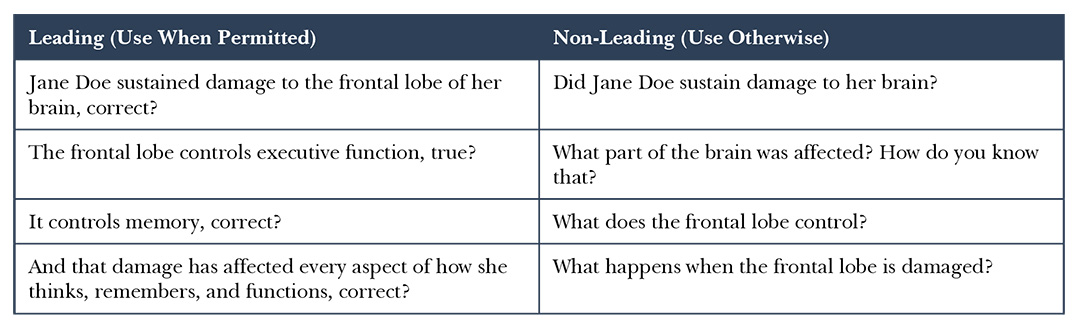
Short, leading questions are often the most effective way to generate clean, concise soundbites for trial. Before you begin, know whether the witness is one you are permitted to lead – an adverse party, officer, director, managing agent, employee, or hostile witness. (Evid. Code, §§ 776, 767.)
If so, lead freely and move on when opposing counsel objects. If not, rephrase the question in a non-leading, open-ended form. The same analysis applies to compound questions. Below are examples of how the same substantive inquiry can be structured both ways:
The broader principle: Structure every question with your trial presentation in mind. Think about what you want the jury to see and hear – a clean, single-answer exchange – and engineer that exchange at the deposition.
Form objections at deposition: Do not ignore them
Typically, I advise younger lawyers to ignore objections they receive during deposition – the court will deal with them down the road. However, this changes when a valid form objection is made during a deposition you plan to show the jury.
Form objections are valid, proper, and must be preserved on the record at the time of the deposition to avoid waiver. (CCP § 2025.460(b).) Common form objections include:
- Ambiguous, uncertain, or not readily understood
- Compound
- Calling for narration or lengthy explanation
- Calling for speculation or conjecture
- Argumentative
- Leading and suggestive, when directed to a witness that the questioner is not permitted to lead
(See Weil & Brown, Cal. Practice Guide: Civil Procedure Before Trial (The Rutter Group 2025) ¶¶ 8:670-8:676.)
When taking a deposition you intend to play at trial, listen carefully and stay alert to form objections. A sustained form objection can render testimony inadmissible or create an awkward gap in your courtroom presentation. Instead of engaging in unnecessary back and forth with opposing counsel, simply rephrase the question to address the potentially valid objection. Do not hope the objection will be overruled later; by then, the deposition is done and you cannot correct it.
The same applies when opposing counsel examines their own out-of-state or unavailable witness at deposition. If they are improperly leading a favorable witness, object on the record or the objection is waived. (CCP § 2025.460.)
A recurring issue arises when out-of-state defense counsel, accustomed to federal practice, objects solely “as to form” without stating any basis. The argument that such an objection is insufficient has real teeth – even in federal court. Under FRCP Rule 32(d)(3)(B), a form objection is waived unless made at the time of the deposition. Under Rule 30(c)(2), any objection “must be stated concisely in a nonargumentative and nonsuggestive manner.”
Several federal courts have held that a bare “objection to form,” without identifying the specific defect, fails to satisfy that standard because it gives the questioning attorney no meaningful opportunity to correct the problem. (See Henderson v. B&B Precast & Pipe, LLC, No. 4:13-CV-528, 2014 WL 4063673 (M.D. Ga. 2014); Wise v. Washington County, No. 10-1677 (W.D. Pa. 2014); Security National Bank of Sioux City v. Abbott Laboratories, 299 F.R.D. 595, 602 (N.D. Iowa 2014).) Other federal courts disagree, permitting a bare “objection to form” unless the questioning attorney asks for clarification. (See Cincinnati Ins. Co. v. Serrano, No. 11-2075, 2012 WL 28071 (D. Kan. 2012); Druck Corp. v. Macro Fund (U.S.), 2005 WL 1949519 (S.D.N.Y. 2005).) In California state court, we would argue the stronger rule applies: CCP § 2025.460(b) requires a specific objection – “form” alone is not enough.
The rule of completeness: Think before you designate
Think carefully before offering only partial excerpts from a deposition, particularly an excerpt that would otherwise be inadmissible at trial. Under CCP § 2025.620(3)(e), a party “may offer in evidence all or any part of a deposition, and if the party introduces only part of the deposition, any other party may introduce any other parts that are relevant to the parts introduced.”
The practical effect is significant. By introducing even a portion of a deposition, you invite opposing counsel to introduce other portions of the same deposition that are relevant to what you played – including portions that might be harmful to your case and that would not otherwise have been admissible. This is particularly important where a deposition is otherwise inadmissible in its entirety; partial use can effectively bring in the whole.
If opposing counsel attempts to introduce additional testimony under the rule of completeness, push back if those additional excerpts are not truly relevant to the portions you introduced. The rule of completeness does not give opposing counsel a blank check to bring in unrelated portions of the deposition. The additional testimony must be relevant to the specific subject matter of what was introduced. (CCP § 2025.620(e).)
Importantly, if the opposing party wishes to introduce additional video testimony in response to yours, they must still comply with CCP § 2025.340(m) by designating the exact excerpts they intend to use in advance.
Don’t forget CACI 208
Whenever you introduce video deposition testimony in trial, request CACI Instruction No. 208, Deposition as Substantive Evidence. This instruction tells the jury that deposition testimony should be considered the same as testimony given in open court. Without it, jurors may not understand the full evidentiary weight they are permitted to give the testimony.
Conclusion
Using deposition testimony effectively at trial requires advanced preparation throughout the litigation stages. The attorneys who walk into the courtroom and can deploy powerful video clips, play admissions from adverse witnesses, and establish foundational records without a live witness on the stand are those who planned for trial from the moment they served the first notice. This type of skill and preparation cannot be improvised on the eve of trial.
The code gives you the tools. Sections 2025.220, 2025.340, and 2025.620 of the Code of Civil Procedure, together with Evidence Code sections 776, 767, 1220, and 1271, create a framework for using depositions at trial that rewards preparation and compliance. Know the rules, build them into your practice from the start, and your depositions will do exactly what they should: Work for you at trial.
Clare Lucich is a partner at Bentley & More LLP in Newport Beach, California, representing plaintiffs statewide in government liability, product defect, personal injury, and insurance bad faith cases. She has been recognized by the Daily Journal as one of California’s Top Women Lawyers and is listed as a Super Lawyer and in Best Lawyers in America.
Cassidy Wakeham is a trial lawyer at Bentley & More LLP. Her practice focuses on personal injury, workers’ compensation, and insurance bad faith. Ms. Wakeham is a graduate of the University of California, Irvine, School of Law.
Clare Lucich

Clare Lucich is a partner at Bentley & More LLP in Newport Beach, California, representing plaintiffs statewide in government liability, product defect, personal injury, and insurance bad faith cases. She has been recognized by the Daily Journal as one of California’s Top Women Lawyers and is listed as a Super Lawyer and in Best Lawyers in America.
Cassidy Wakeham

Cassidy Wakeham is a trial lawyer at Bentley & More LLP. Her practice focuses on personal injury, workers’ compensation, and insurance bad faith. Ms. Wakeham is a graduate of the University of California, Irvine, School of Law.
Copyright ©
2026
by the author.
For reprint permission, contact the publisher: Advocate Magazine