
Discovery goals with truck driver behavior-monitoring systems
What evidence to get from telematics monitoring systems and how to use it
Whether your defendant driver was behind the wheel of a big truck or a smaller company vehicle, you need to launch your investigation well before your court authorizes formal discovery. You need to start immediately, by communicating with adjusters, law enforcement, EMTs, witnesses, etc. One of your first efforts should be to determine whether the defendant vehicle was equipped with any sort of telematics and driver-behavior monitoring system(s), and, if so, to request preservation of that evidence right away.
As described by one of the major providers:
At its core, a telematics system includes a vehicle tracking device installed in a vehicle that allows the sending, receiving, and storing of telemetry data. The device collects GPS data as well as an array of other vehicle-specific data and transmits it via a cellular network or satellite communication to a centralized server. The telematics data captured can include location, speed, idling time, harsh acceleration or braking, fuel consumption, vehicle faults, and more. When analyzed for particular events and patterns, this information can provide in-depth insights across an entire fleet.
These systems have become so common that my default setting is to believe there was one and that there will be at least some data available (far beyond EDR/black box type data). This article covers some of the common evidence that will exist when your defendant company uses a driver behavior monitoring and tracking system, covers some ways to obtain it, and then covers how to use it in practice.
Some of these systems are more sophisticated and some less, so the data you can get will vary from case to case. Either way, send a preservation letter telling them to preserve all such data, and then set out to get your hands on it. Preservation letters should be sent to the defendant company, its driver, insurance carriers, third-party adjusters, and the telematics provider, too. Also consider sending one to law enforcement, tow yards, and businesses near the crash scene (for example, to get surveillance footage).
Getting ready to file
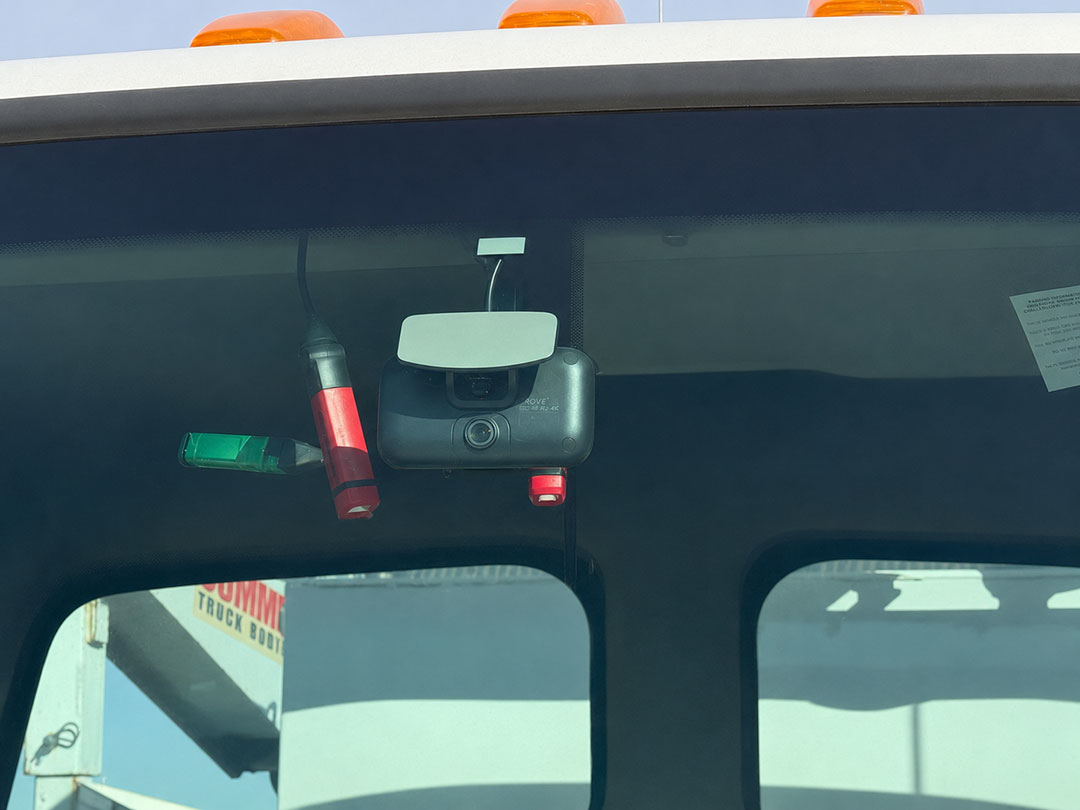
Assuming there is no specific mention of a monitoring system in the police report, the first place to look is in the photos taken by law enforcement or other witnesses of the crash scene. Look specifically at the defendant vehicle photos, to see if there is a dash cam mounted to the windshield or elsewhere (Figure 1).
If there are no photos showing that space in the vehicle, talk to the investigating officers to learn what they know about it and do everything you can to set up an inspection of the vehicle so you can see for yourself. Communicate with as many people as necessary (in-house counsel for defendant, adjusters, law enforcement, tow yards, etc.) until you find the vehicle. Hire an expert to go inspect the truck/vehicle in person.
If no camera or other device is there, be sure to also look to see if there is a mark on the windshield indicating something was mounted there but has been removed. It happens more than you think! Inspections almost always provide valuable information. If you are not able to get it inspected before filing suit, that’s all the more reason to get the case on file ASAP.
Some companies use simpler devices that can be plugged into an electrical outlet on the dashboard, which can make removal even easier and harder to track. Those devices have more limited capabilities, such as perhaps GPS tracking only. If you’re dealing with a big truck, any electronic logging device (or ELD), which works by synchronizing with the truck’s engine control module (ECM), will also record information like hours of service and driving time, GPS location data, and other trip data. Gather all of this data, even if you don’t know yet what piece of the story it might tell. The day will come soon when this data can potentially rule in or rule out different theories of your case, and different theories of the defense.
With the camera/telematics system itself, whether its Omnitracs, Lytx, Motive, Samsara, Netradyne, Verizon Connect, Geotab, or whichever, each of the units/devices typically has a serial number, a QR code, or some other identifying information. Find it and make sure to include that identification number in your supplemental preservation of evidence letter and in your requests for the data. The law on spoliation of evidence directs that if an organization knows that evidence may be relevant to actual or threatened litigation, then it has to preserve that evidence.
And if you cannot find that ID number anywhere in the materials you have, again, do what you can to inspect the vehicle immediately so you can find it. Look for driver-facing and forward-facing cameras first, but also look for any auxiliary cameras, such as on the tractor’s fenders or on the back of a trailer.
Aside from the serial/ID number, make sure to include as much other identifying information as possible in your preservation of evidence letters. But ultimately, you can only do so much informally. The real work comes when you get into the trenches of litigation. Once you’ve filed suit, you can serve requests for production, requests to inspect, and subpoenas, and when you can move to compel production/compliance.
In discovery
Even if you obtain the specific serial number, QR code, or other information identifying the device installed in the defendant vehicle before litigation, send interrogatories and requests to produce as soon as discovery opens, asking for all of the serial numbers, etc., associated with all of the devices in all of the company vehicles driven by your defendant driver. If you were able to inspect the vehicle before filing suit and found a device, that may have been just one of the vehicles and devices associated with your defendant driver’s driving for this company.
With these serial numbers you can specifically identify the correct devices, which will allow Samsara (or whichever provider it is) to locate the data you need. Do it through both requests for production/requests to inspect and through a subpoena served on the service provider for the same data. Plan on motions to compel too.
The evidence
When you identify the correct devices, there is a trove of fun evidence available. And that data can tell a much more thorough and accurate story identifying root causes than a scene investigation only about what happened on the roadway in the moments before the crash. First, never forget there should almost always be data from the vehicle’s ECM, ACM, and other “black box” type devices that have been standard equipment for decades. This will give you a lot of hard evidence about things like speed, braking, steering, throttle, cruise control, yaw rates, and other data points in the several seconds leading up to the crash. Look also for data from ABS brake systems in large vehicles, such as brake manufacturer Bendix (now owned by Rand McNally) and its Safety Direct system. To learn what else a large truck was equipped with, request the truck’s “build sheet” from the defendant trucking company.
With camera telemetry systems, get a copy of the contract/service agreement (and all previous and current addendums to it) entered into between the defendant company and the service provider. Who signed it on behalf of the customer, and who is identified as the customer? Look also to the sections of the contract outlining the services to be provided and the customer’s access to those services. The customer makes many decisions about how to configure the services they want included in their package, including things like which driving behaviors it wants to capture and how it wants to learn about them. Also request a price-quote sheet identifying what was and what was not purchased by the customer. This type of document can show the extent to which the services were or could have been customized by the customer.
If you sent a preservation letter early enough in a dash-cam case requesting all footage for a period of time before the crash, there should be way more footage than just the short 12-second clip right before and at the moment of the crash. Depending on the provider and the services purchased by your defendant company, there can even be well over 100 hours of video footage collected and stored by the provider. If it was not preserved, ask why not and keep digging.
If you’ve got a crash involving a mechanical/break down issue on the defendant vehicle, these telemetry systems can provide truck/mechanical/systems diagnostics information as well. One of the primary motivations for why these systems are used is to keep track of the freight being hauled, so the company can reduce losses and better protect its margins. So, they want to know right away, so they can respond and fix the issue, if a rig is ever experiencing any mechanical/systems problems. This diagnostic data can often tell you what, when, and how in a negligent maintenance case against the company.
You can also get all of the 12-second triggered-event video clips generated by your defendant’s driving behavior over the months before the crash (may depend on retention destruction policies if no preservation was sent). Triggered events can include the basics like hard-braking events, harsh-acceleration events, harsh-cornering events, and speeding events, which can be measured by an accelerometer in connection with a GPS device.
They can also include far more than that, depending again on the devices installed in the vehicles and the customer’s settings. For AI-based camera systems, the software is designed to detect and track triggered events like: distracted driving, cell-phone use, rolling stops, lane departures, following too close, driver fatigue, and many other behind-the-wheel issues and behaviors, depending again on how much the customer is willing to monitor.
Each triggered event should be recorded in a video clip, and the system records details about the triggered event for, ostensibly, supervisory review. Events are often scored on a scale (often categorized by the customer, perhaps corresponding to its disciplinary policy). Request all such existing data and video footage so you can learn about the driver’s recorded driving behavior in the weeks and months before your client’s crash.
Reports from coaching sessions are also generated in these systems. When a triggered event happens that the customer had already decided (in its settings) was unacceptable, the system generates a training session in connection with and after the event. The reports typically provide date of event, screenshots from the cameras from the event, date of the (usually later) coaching session, the type of triggered event, the behavior identified, any notes made by the “coach”/supervisor about the session, and a conclusion about the action taken.
Always check to see if the action taken conforms with company policy. If there was no coaching session, why not? Was the lapse a one-off or part of a pattern? When the defendant company boasts that it’s a safe company because it uses this state-of-the-art tech, that boast is impeachable by evidence that the company ignores the data it’s getting or doesn’t enforce its own disciplinary policy.
Best of all, many of the providers will also compile this information on a driver-by-driver basis in summary format. These reports can cover incremental periods, such as monthly, and they include statistics about the driver’s driving. These reports can tell you the number of miles driven, along with the number of various triggered events during those miles like speeding, harsh cornering, and hard braking events. Some reports give other handy information such as the average number of miles driven between each triggered event.
These reports can provide a clean snapshot of how risky a driver’s behavior is on a regular basis, which is also a clean snapshot of what the company knew about the driver’s behavior before the crash. Then you need to find out what the driver’s supervisor did or did not do with this handy information.
The settings of the event-recording device
An important framework to establish in depositions is that, via the service contract, the customer (your defendant company) makes many critical decisions about how to adjust its settings and preferences for how it uses the services and features available. Did the company want to be notified about every violation of company policy, every unsafe behavior detected, or just a limited selection of events? Find out if it is more expensive to receive notifications and summary reports. Did the company save money by choosing to not be provided with these things? Or is it all included and the defendant company just wasn’t accessing it? You can try to depose the service provider itself to confirm this, but it can also be done through depositions of dispatchers, managers, safety directors, and/or officers of the defendant company, not to mention of the company itself.
Somebody at the company will have worked with a rep from the provider to implement, adjust, and/or maintain the monitoring system. This person can testify about what the company tracks, who gets notified or looks at the information, and how that information is used in the company. How much these people know may be a crapshoot. But know that every time the driver-facing camera detects, for example, a distracted driving event (like a driver looking at his phone), the system can also be sending push notifications to a person designated by the customer to receive them, either by email, text, or however they want. They can also set it up so that they don’t receive any notification for distracted-driving events.
Those events may just be part of a summary report the designated person can access each month instead. They may even be able to adjust what counts as a distracted-driving event – such as, a driver looking at his phone for five seconds or more constitutes a distracted-driving event, but not for anything less than five seconds. Or, they can change that to three seconds. Bottom line is a lot depends on how the customer wants it set up.
Another example is the settings for what will constitute a speeding event. The customer can adjust the settings so that a triggered event for speeding occurs every time the driver has been going at least five mph over the limit for at least 10 seconds. Or, the customer may choose for a triggered-speeding event to occur only when the driver is going 20 mph over the limit for at least five minutes.
The settings could include an in-cab audible alert for the driver when this trigger occurs, or not. The way the customer adjusts the settings could also cause notifications to be sent to the supervisor when this trigger occurs, or not. There is much to learn about how the settings are configured on the different types of risky driving behaviors. And of course, asking why they made those choices will often lead to helpful admissions about the defendant company’s true priorities.
How quickly does the customer want reports of a triggered event? The service provider can notify the customer’s designee immediately, or via a monthly summary report, or anywhere in between. The customer can request an in-cab audible alert for the driver when the system records a triggered event; the customer can also deselect that from its settings. The notification settings chosen by the customer tell an important story about whether its advertised commitment to safe driving is real, or just a smokescreen.
If the people working for your defendant company are too unsophisticated or uneducated on the details of the telematics services, features, settings, etc., you should consult an expert witness who knows and understands that particular service provider. A great way to get information about the settings and all of the data available is to serve a request to inspect the defendant company’s online user interface/customer portal using your expert. Both sides can have an expert present, and protocol can be agreed upon in advance so neither side can have complaints about how the information was obtained.
With all of the video footage and data about your driver obtained, along with a host of information about how the defendant company uses the services of its driver-behavior monitoring system, there lies your path to showing the company knew its driver was risky and was either ignoring it or was simply tolerating it. Think about those summary reports showing risky driving behavior. Every report of a triggered event, and the evidence of the company’s response or non-response, matters. A pattern of non-responses impeaches the credibility of the company when its representatives and counsel insist that safety is the company’s first priority.
Prove control
You must identify both the telematics service provider’s customer (is it your defendant company or some other entity?) and the person who worked with the provider to implement the system and/or to make adjustments to it over time. The person authorized by the customer to work with the provider, i.e., the person/company making the decisions on things like 1) what behaviors and information to track, 2) which available features to utilize, 3) how to adjust the settings, 4) whether and how to receive notifications for any given triggered event, etc., is exercising control over the manner and method for how the drivers behave while behind the wheel.
In commercial and company-vehicle situations, there are often multiple entities involved, such as the various parties involved in a freight trip or parent/subsidiary-type situations. Typically, all but one of the entities will deny being an employer of or in any way responsible for the driver. This is where the service contract comes into play, as well as the measures taken to implement and operate under the driver-monitoring system.
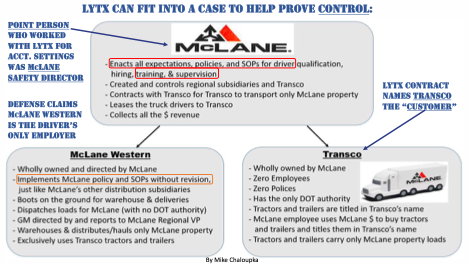
The image below is a trial demonstrative from a case where parent and other subsidiary companies were denying being employers of the driver. But the Lytx contract and how it was implemented proved the parent company was asserting control over the driver, even though he was technically on the payroll of its subsidiary. The demonstrative contains other information too, but the driver behavior-monitoring portions of it are highlighted (Figure 2).
Prove negligent training/supervision
Even if you find that the company was paying some attention to what its telematics provider was revealing about its drivers, and even if the company is doing coaching sessions or providing re-training after triggered events, that doesn’t mean the company was being reasonably careful. After all, yet another triggered event occurred and this time it was a bad crash. So how did that still happen? You must always ask: What did the company know and when did it know it? And, what did it do or not do with that information?
The reality is that the coaching programs are often toothless, and the coaching sessions are completely ineffective. If a driver’s attitude is that he can speed or scroll on his phone whenever he wants, then a two-minute coaching session will not change that attitude. The company must have the will to terminate that driver and hire another one with a better attitude.
For example, one motor carrier I know was using its dispatchers to review triggered events and perform coaching sessions. But not one of these dispatchers had a CDL or had ever driven a big truck. Even worse, these dispatchers were not given any other information about the driver’s history when going to administer a coaching session. In other words, the “coach” has no idea whether this is the first distracted-driving event for this driver or the 10th. So, in effect, these coaching sessions were being done in the blind.
What was really happening was that the “coach” would just find the driver in the terminal/yard, pull them into a room to show them the video and coaching form, and the driver would argue with the dispatcher about whether he or she really did something unsafe. It was a repeating cycle. This is ineffective; it was a big reason why triggered events kept happening with the driver in this case, and it’s also why the crash happened to my client.
Fits into standards of care
Defendant companies often say their use of these telematics systems and the way they work is not evidence of the industry standards for being a reasonably careful company with vehicles on the road. They say it’s going above and beyond, and that there is no law requiring the use of things like dash cameras, etc. They try to use this to argue your expert’s opinions are unreliable before trial, and they make these arguments to juries.
Don’t be fooled (and don’t let your judge get fooled either). These are simply tools that provide a way to supervise and train drivers, and to assert the level of control required for the safe driving of its vehicles.
The duties of a company/entity to monitor and assert control over the way drivers operate its vehicles are easier to establish in commercial motor-vehicle cases. (49 C.F.R. 385.3, 385.5.) The same is true for the standards by which these trucking companies must assert that control, and to which they must hold their drivers accountable. (See, e.g., Federal Motor Carrier Safety Regulations, Uniform Commercial Driver’s License Manual, the Preventable Accident Manual, J.J.Keller.) But even in a case with a non-CMV fleet/company vehicle, there are other standards like ANSI (ANSI/ASSP Z15.1-2024 Safe Practices for Motor Vehicle Operations, American Society of Safety Professionals.) on point. While AI-based cameras and other telematics devices are new, they are simply another (better) tool to be used by the industry. They serve the same purpose as a good, old-fashioned, preventability accident analysis; it’s just that they’re more high tech.
Go forth!
These systems are becoming more advanced every day. With the AI components alone, we know there will be advancements coming fast. Keep digging in every case. Where evidence has been lost or is otherwise unavailable, focus your story on why and what could have been prevented if the information was preserved. Go forth and fight!
Mike Chaloupka is a trial lawyer and the managing partner at Metier Truck Crash Lawyers, and is licensed in Oregon, Washington, Colorado, and Wyoming. He is a 2011 graduate of the Trial Lawyers College and an everyday practitioner of its methods. He holds a Class-A CDL, and his practice is focused on commercial truck crash and trucking-adjacent personal injury and wrongful-death cases.
Mike Chaloupka

Mike Chaloupka is a trial lawyer and the managing partner at Metier Truck Crash Lawyers, and is licensed in Oregon, Washington, Colorado, and Wyoming. He is a 2011 graduate of the Trial Lawyers College and an everyday practitioner of its methods. He holds a Class-A CDL, and his practice is focused on commercial truck crash and trucking-adjacent personal injury and wrongful-death cases.
Copyright ©
2026
by the author.
For reprint permission, contact the publisher: Advocate Magazine