
GPS evidence in collision cases
Used properly, it answers comparative-fault theories before they reach the jury
The amount of Global Positioning System (GPS) data collected by individuals and companies is increasing rapidly; as an attorney, if GPS data hasn’t already touched your cases, it’s only a matter of time before it does. At its core, GPS data can contain information about time, position, and speed. The data can be incredibly informative and powerful, but its limitations need to be properly understood and communicated. Used well, it answers comparative-fault theories before they reach the jury. Used carelessly, it sinks the case it was meant to save.
A cyclist, a descent, and a defense theory that collapsed
Consider the case of a cyclist on a professional road bike who was descending a posted 35-mph roadway when he was cut off by a motorist. From the first round of discovery, the defense theory was unmistakable: The bike was expensive, the descent was steep, and therefore the cyclist must have been speeding. Comparative fault is telegraphed in every interrogatory response. The defense builds a theory that assumes plaintiff was cycling well above the speed limit.
Thankfully, the plaintiff was wearing a wrist-based GPS device running Strava. We pulled the data early, authenticated it through the platform, and retained a qualified reconstructionist to interpret it with appropriate attention to the device’s known accuracy and uncertainty characteristics. The data showed steady-state speeds within the posted limit across the entire descent – not just at the point of impact, but consistently throughout the ride. The defense speeding theory crumbled, liability was ultimately admitted, and the case settled.
Data from GPS devices is now available to plaintiffs’ lawyers in a substantial share of personal-injury matters. They are not, however, available to lawyers who do not look for the data, do not preserve it before it gets overwritten or ages off platform servers, and do not present it with appropriate candor about its limits. The technical research summarized in this article gives us a comprehensive quantification of how accurate this data is and how it can mislead. This article translates that research into our personal injury practices.
What the data can – and cannot – tell us
Consumer-grade devices that record position, speed, and potentially other kinematic, physiological, or vehicle data over time are commonly available as bicycle computers, wrist watches, fleet-management systems, applications installed on smart phones, and even cameras. The device’s position is calculated from signals received from one or more satellite constellations that orbit the earth, commonly known as Global Positioning System (GPS) data.
The device’s speed can then be calculated from the time sequence of position data, a doppler shift in the satellite signals, or in some cases, from an external sensor. Position and speed data are useful for determining the motions of the device – and by inference the wearer, user, or their bicycle or vehicle – before, during, and after a crash or other mishap; however, they are only useful if their accuracy and precision are known.
Over the past few years, Los Angeles-based MEA Forensic has quantified the accuracy and precision of consumer-grade GPS devices and published their research through the Society of Automotive Engineers. That research has provided the collision reconstruction community with additional understanding of the nuances of these devices and better quantification of the accuracy and uncertainty of the time, position, and speed data for 13 commonly used devices.
GPS timing is not the ground truth
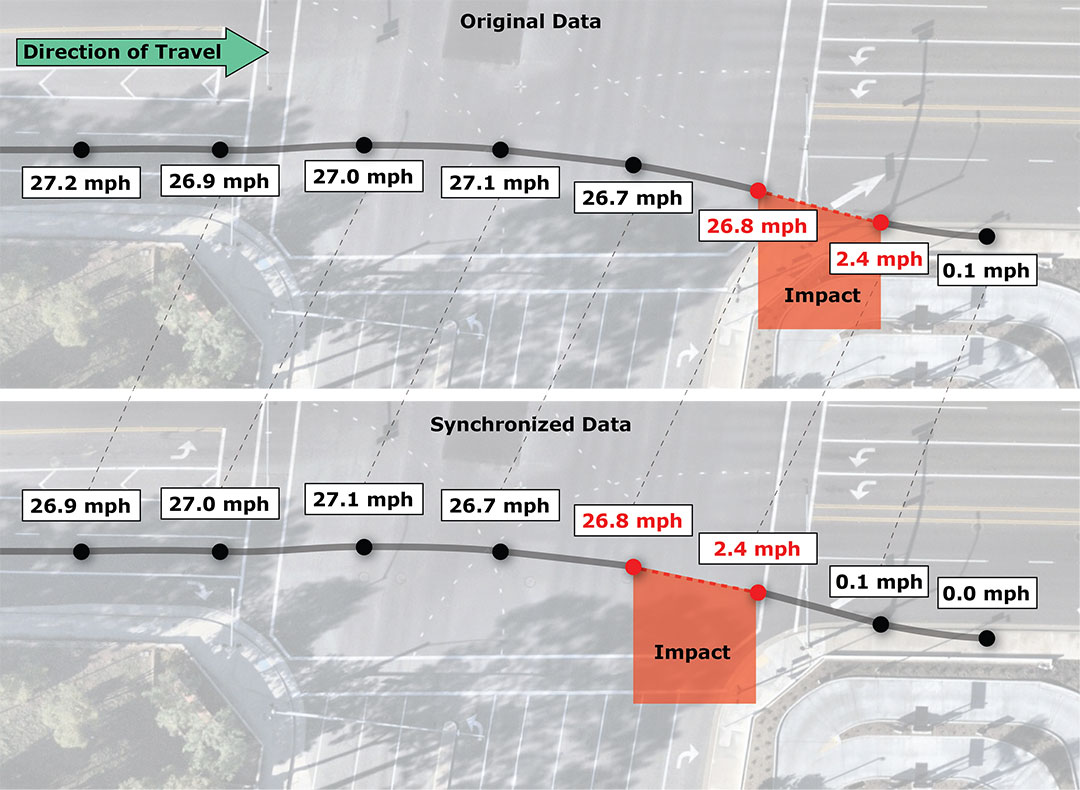
It is tempting to interpret timestamps from GPS data files in two ways: firstly, to assess the true time an event occurred, and secondly, to synchronize position, speed, and other potential data streams. However, through our research, we found that the offsets between the device timestamps and the true time were variable and occasionally large (in one anomalous case, it was off by three minutes), complicating, but not eliminating, the possibility of the first interpretation. We have also found that the position and speed values associated with the same timestamp recorded within a single device are not necessarily synchronized (i.e., the speed reported at a given timestamp may correspond to the position at the previous timestamp).
Though, across all devices we tested, this temporal offset between the position and speed signals was consistent and small, allowing it to be corrected for and interpreted accurately. If an investigator fails to account for the possible time lag between the speed and position data, the pedestrian, cyclist, or vehicle may be misplaced in the key moments preceding and at impact.
The position data has substantial uncertainty
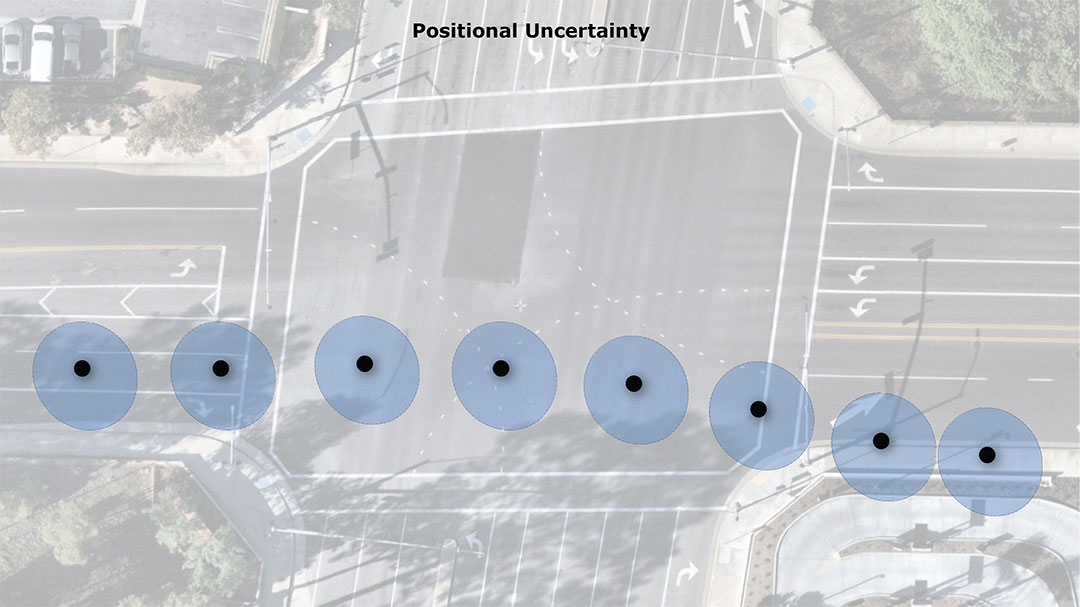
The uncertainty in GPS position is different depending on the device used to record the data. Among the devices we’ve tested, the uncertainty of the GPS position data ranged from within 11 feet to within 24 feet of the true position 95% of the time. This uncertainty is large compared to a 4- to 6-foot-wide bicycle lane and comparable to one or two standard 10-to-12-foot-wide vehicle lanes. Expressed as areas, the smallest 95th percentile confidence ellipse was 211 square feet, similar to the size of a one-car garage, and the largest was 1,582 square-feet, similar to a volleyball court. Because of these relatively large areas of positional uncertainty, careful interpretation is required for establishing possible travel paths to and locations at impact.
The speed data
is more accurate
Speed data from consumer-grade devices is among the most accurate and precise data we are likely to have access to in a collision investigation; however, like with the position data, its accuracy is device dependent. Among the devices we’ve tested, GPS-reported speeds were highly accurate, their median error was either 0 mph or underreported speed by less than 0.1 mph. The GPS reported speeds were also precise: reported speed values fell within -1.6 to +0.9 mph of the true speed 95% of the time. This level of accuracy and precision should give investigators reasonable confidence when using the data to estimate a pedestrian’s or cyclist’s speed leading up to a collision.
Position and speed data uncertainty is location dependent
Both the position and GPS-based speed data uncertainties are sensitive to the geographic location where the data was acquired. We recorded and analyzed 96 hours of data at one-second intervals during road cycling rides split between Vancouver, Canada and Orange County, California. We found that the positional uncertainty was 22% greater in Vancouver than in Orange County. One possible explanation for this difference could be the presence of more tall buildings and trees adjacent to the cycling routes in Vancouver, limiting upward visibility to the satellites.
As expected, for devices that use the GPS data to calculate speed, the resulting speed data uncertainty is also location dependent. We found that the speed uncertainties recorded in Vancouver were 70% greater than in Orange County. Part of the difference in uncertainty can be explained by the devices consistently underreporting the speed in specific tight curves in Vancouver. Therefore, the location where the GPS record was made, the upward visibility to the sky, and specific roadway features such as tight curves must be considered when assessing the GPS-based speed uncertainty.
Due diligence is required to establish the source of the speed measurements for the particular device in question. Location-based considerations are not relevant for devices that measure speed using external sensors, such as wheel-based speed sensors on bicycles or other-vehicles.
Data artifacts
Although the GPS positional and speed data uncertainties are mostly well-behaved, we have seen a number of artifacts in the data which could be misinterpreted or misleading. For example, the positional data in one instance (out of nearly 500 data files investigated) showed the GPS path starting at a location about 1.8 miles from the true location and gradually migrated onto the correct path over a period of about seven minutes. In the speed data, we have seen many instances of false non-zero speeds, speed dropouts (reported zero speeds when the true speed is nonzero), and unrealistic spikes. In most cases, these data artifacts are identifiable via an investigation of the reported speed data because the implied acceleration or deceleration of the bicycle would exceed the capability of a cyclist to accelerate or a bicycle’s braking ability.
GPS data can be used to show habits and patterns
If there is GPS data for the incident-related walk, run, or ride, there will usually be data from similar non-incident-related activities. This data could be used to inform typical routes, reduce the uncertainty in lane choice, inform speed estimates, and potentially show differences in activity levels pre- and post-incident.
Once the data has been understood for what it is and what it is not, the next question is how to find it before it disappears and how to use it in your case.
The early-case playbook
GPS evidence is unlike most other forms of evidence in one critical respect: It can disappear. The single most important thing a plaintiff lawyer can do in a case where GPS data may exist is to act quickly.
Intake. Build the question into every PI intake. Does the client wear a fitness watch? Use a phone-based fitness app? Have a bike computer? Drive a vehicle with telematics or infotainment-system GPS? Have a family-tracking app like Life360 or Find My? Use ride-share apps? Carry an employer-issued device? Have a dashcam? Many clients do not realize what data they are generating. The intake form should prompt them to check. It wasn’t until my first case involving a bicyclist and a Strava device that I understood the importance of these types of questions at the intake level.
Client-side preservation. Once devices and accounts are identified, give the client written instructions: Do not delete, do not “clean up” accounts, do not change privacy settings, do not switch devices, do not let a family member borrow the watch or device. Capture and export the data early. A client-initiated export from Strava, Garmin Connect, Apple Health, or Google Fit of all the file formats available for the data takes minutes and creates a preserved record independent of the platform’s retention practices.
Third-party platform preservation. Send preservation letters to the relevant platforms. Practical reality: Platform responses to civil preservation letters are inconsistent and slow.
Defense-side discovery. On the defendant’s side, GPS data is often more abundant than plaintiff counsel realize. Modern vehicles record substantial telematics and event data; commercial defendants often have fleet-management systems with GPS data points collected as regularly as once per second; employer-issued phones and tablets generate location histories; and dashcams have become common. Your initial set of discovery should target all of these categories. For commercial defendants, the retention policies governing this data are themselves discoverable and worth requesting – gaps and rolling deletions are easier to challenge when the policy is in evidence.
Getting it in: Foundation without issues
GPS evidence is not exotic and the foundation should not be either. The path through the Evidence Code is well-marked.
Authentication. Evidence Code section 1552 creates a rebuttable presumption that a printed representation of computer information accurately represents the computer information it purports to represent. Evidence Code section 1553 provides a parallel presumption for printed representations of images stored on video or digital media. Those presumptions help establish that the printout, report, or image accurately reflects the stored data, but they do not by themselves prove the underlying GPS data are reliable or that the device was functioning properly. That separate foundation should be supplied through a custodian, user, investigator, or expert familiar with the device, platform, export process, and relevant limitations.
Hearsay. Machine-generated output is generally not hearsay because no human declarant is making an out-of-court statement. The most directly analogous California authority is People v. Rodriguez (2017) 16 Cal.App.5th 355, where the Court of Appeal upheld admission of a computer-generated GPS report from an ankle monitor. The court held the GPS report was not hearsay because the location data were automatically generated rather than stated by a person, and that testimony from a witness familiar with the system was sufficient for authentication.
Further, the California Supreme Court applied this analysis to automated traffic-camera output in People v. Goldsmith (2014) 59 Cal.4th 258 and the Court of Appeal applied parallel reasoning to a computer’s internal date-and-time records in People v. Hawkins (2002) 98 Cal.App.4th 1428. Both lines of authority support the conclusion that consumer GPS exports – automated machine recordings of position, speed, and time – are non-hearsay machine output rather than statements by a person.
Defense counsel may attempt to analogize GPS exports to social-media content under People v. Beckley (2010) 185 Cal.App.4th 509, to argue that digital evidence is susceptible to manipulation. But Beckley involved user-generated social-media/web content, not automated machine output. Goldsmith distinguished Beckley on that ground, and Rodriguez is the better analogy for GPS data.
Business records. Where the production includes platform business records, account records, custodian declarations, or records produced by subpoena, Evidence Code sections 1271 and 1561 provide the ordinary business-records route. But for the automated GPS coordinates, speed, and timestamp fields themselves, Goldsmith, Hawkins, and Rodriguez support a non-hearsay machine-output theory, while authentication and system reliability remain separate foundation issues.
Expert foundation. Evidence Code sections 801–802 govern expert opinion, and Sargon Enterprises v. USC (2012) 55 Cal.4th 747, supplies the gatekeeping framework. Sargon’s central question – whether the matter relied upon by the expert is of a type reasonably relied upon, and whether the reasoning is sound – maps directly onto whether the expert has accounted for device-specific accuracy and uncertainty. This is exactly where the technical research summarized in this article earns its keep: Peer-reviewed quantification of uncertainty for specific consumer devices gives the expert a defensible foundation rather than the kind of ipse dixit that draws Sargon motions.
Kelly. People v. Kelly (1976) 17 Cal.3d 24, as preserved in People v. Leahy (1994) 8 Cal.4th 587, governs the admissibility of new scientific techniques. The mere admission of conventional GPS location records is usually better framed as an authentication, reliability, and expert-foundation issue rather than a Kelly issue. But where an expert offers a novel scientific technique layered on GPS data – for example, a bespoke synchronization correction, device-specific error model, or machine-learning interpretation of raw fixes – counsel should evaluate whether Kelly/Leahy must be addressed.
Using it at trial
A. Affirmative use. Return to the cyclist on the descent. The defense theory required the cyclist to have been speeding; the Strava data showed steady-state speeds within the posted limit across the entire ride. The moment the data was disclosed and authenticated, the defense was forced to abandon its primary comparative-fault theory and pivot to a fallback.
The result was made possible, not by the data alone, but also by the experts who interpreted it. Retained experts fluent in the nuances of GPS evidence – the device-specific uncertainties in positional data, the timing offsets, the artifacts that can mislead an untrained reader – give plaintiff counsel two compounding advantages. They produce an accurate, defensible reconstruction of the event in the affirmative case. And they equip counsel to scrutinize a defense expert who may not fully appreciate those nuances, who may have skipped the artifact screening, or who may have applied published tolerances to an environment those tolerances were never validated in. In a contested case, the second advantage is often as decisive as the first.
The same affirmative use is available across the evidentiary categories the experts outlined above. Lane-position arguments where the 95th percentile confidence ellipse at least partially captures the bike lane are powerful precisely because they account for uncertainty rather than ignoring it.
Prior-activity GPS can also support a habit or custom argument where the history is regular, specific, and comparable enough to qualify under Evidence Code section 1105. In other cases, the same data may be better used more modestly: to show typical route choice, contextualize lane-position uncertainty, corroborate damages, or impeach an assumption-driven reconstruction. Damages corroboration through pre- and post-incident activity comparisons frequently lands harder with juries than expert testimony alone, especially when presented through clean visual displays of weekly mileage or ride frequency over time.
B. Impeachment of defense reconstructions. Defense reconstructions built on assumed speeds or paths are vulnerable when contemporaneous GPS data exists. As discussed above, common and anomalous data artifacts – false zero-speed readings, unrealistic acceleration spikes, positional drift of more than a mile in one recorded case – can be identified by someone who knows to look for them.
A defense expert who failed to screen for artifacts in the data they relied on has done sloppy work the jury should not credit. Where the omission leaves the defense opinion resting on an unsupported speed, path, or timing assumption, a Sargon motion may be appropriate. In other cases, the omission may be better used as impeachment: The expert reached a reconstruction opinion without addressing contemporaneous data that bore directly on the assumption.
C. Deposing and cross-examining the defense GPS expert. Not every case is the cyclist on the descent. Sometimes the defense has its own GPS data, or the data cuts against the plaintiff in some respect. Fluency with the technology that supports affirmative use also supports effective cross-examination. A working checklist for the defense GPS expert:
- Device model. Device-to-device variation is real and measurable; published tolerances for one model do not necessarily apply to another.
- Sampling rate. Many devices report data once per second, a few record at higher rates, and others record irregularly and on the order of minutes rather than seconds. The sampling rate limits what can reliably be inferred about short-duration events, acceleration, and deceleration.
- Sky visibility at the incident location. Urban canyon, dense tree cover, and proximity to tunnels or large structures degrade positional accuracy. The expert should have considered the satellite visibility environment specific to the incident location, not relied on tolerances measured elsewhere.
- Speed derivation method. The expert should know whether the device derived speed from differentiation of position over time or from Doppler shift on the satellite signal. The two methods have different error characteristics.
- Artifact screening methodology. What did the expert do to identify and exclude false readings? Did they review the speed data for physically implausible accelerations, the position data for drift, or the speed channel for spikes and dropouts?
- Synchronization between position and speed channels. Within a single device, the speed reported at a given timestamp may correspond to the position at the previous timestamp. An expert who has not accounted for this lag may have placed the cyclist, pedestrian, or vehicle in the wrong location at the moments preceding and at impact.
- Geographic variance from validation environment. Where were the device’s tolerances validated, and how does that environment compare to the incident location? MEA’s research has documented materially greater positional and speed uncertainty in some environments than others. An expert who has applied published tolerances without considering the validation environment has done incomplete work.
These questions also support Sargon-motion practice. Opinions that overstate precision or ignore device-specific uncertainty are vulnerable to exclusion under the gatekeeping standard, and peer-reviewed sources quantifying that uncertainty are the kind of authority that gives a Sargon motion teeth.
Privilege and work-product
When reconstructionists initially review a client’s GPS data, counsel should distinguish between the underlying data and counsel’s consulting-expert work product. The client’s raw, nonprivileged GPS data does not become privileged merely because counsel or a consultant reviewed it. But counsel’s communications, impressions, and a consulting expert’s preliminary analyses may be protected under Code of Civil Procedure section 2018.030 and the consulting-expert authorities. Once an expert is designated to testify, expert-discovery obligations may require production of discoverable reports and writings prepared by the designated expert in forming the opinions to be offered at trial.
Counsel should also treat personal GPS histories as privacy-sensitive. When seeking or producing non-incident activity data, limit the production to reasonably comparable activities, relevant time periods, and the issues actually in dispute. Overbroad collections of location history can create avoidable privacy, proportionality, and Evidence Code section 352 problems.
Closing
GPS data can add tremendous value to our understanding of an incident, but can be persuasively misleading without proper scrutiny. The technical analysis required to interpret GPS data competently – to account for device characteristics, screen for artifacts, address geographic variance, and quantify uncertainty in a way that survives Sargon – is not work that can be done in the weeks before trial. The expert’s early engagement on cases involving GPS data is generally repaid many times over in settlement and trial outcomes.
This technology is expanding, not contracting. Connected vehicles, wearables, and app-based tracking are generating more data, more often, in more places. The plaintiffs’ lawyers who develop fluency with this evidence now will have a durable advantage over those who treat it as a curiosity. The cyclist on the descent is not a one-off. It is the new normal.
Kristopher Peerali is a co-founding partner at Peerali Law with an expertise in litigating and trying catastrophic personal-injury matters. He can be reached at This email address is being protected from spambots. You need JavaScript enabled to view it. www.peeralilaw.com.
Gabrielle Booth, PE, is an engineer in the Collision Reconstruction group of MEA Forensic’s Los Angeles office. She investigates traffic collisions and leads research on GPS and telematic data. She can be reached at This email address is being protected from spambots. You need JavaScript enabled to view it. www.meaforensic.com.
Kristopher Peerali

Kristopher Peerali is a co-founding Partner at Peerali Law with an expertise in litigating and trying catastrophic personal injury matters. He can be reached at kris@peeralilaw.com www.peeralilaw.com.
Gabrielle Booth

Gabrielle Booth, PE, is an engineer in the Collision Reconstruction group of MEA Forensic’s Los Angeles office. She investigates traffic collisions and leads research on GPS and telematic data. She can be reached at gabrielle.booth@meaforensic.com www.meaforensic.com.
Copyright ©
2026
by the author.
For reprint permission, contact the publisher: Advocate Magazine