
Sitting on their shoulders
Using one defense expert to take apart the next one
Nearly three hours into a Saturday deposition, the defense accident reconstructionist was walking me through slide 35 of his 69-slide presentation. He had synchronized surveillance video with the tractor-trailer’s brake data, identified the frame where the brake lights went off, worked backward through the timing, and calculated the truck’s speed at impact. He was proud of the work, and he should have been. It was detailed, technical, and impressive.
After walking me through the calculations, he said, “I know it’s a lot of work to get to a simple opinion, right?” I responded, “Listen, it’s fascinating.” He laughed and said, “You should have been an engineer.” My response was immediate: “I can’t do math.”
That part was true, but it also did not matter. You do not have to out-engineer an engineer to take a good engineering deposition. You do not have to become a human-factors expert to cross-examine one, and you do not need a medical degree to expose the limits of a medical opinion. You have to prepare, understand enough of the science to know what matters, and sometimes be willing to let the expert teach you the rest.
There are different schools of thought about expert depositions. One approach is to get the opinions, understand the bases, lock the expert down, and save the strongest impeachment for trial. Why educate the witness or show the defense where you are going? There are cases where that makes sense. I usually take a different approach.
When I take an expert deposition, I am thinking about trial and everything that happens before it. Can I change the defense’s evaluation of the case, develop testimony for a motion in limine, expose an assumption another defense expert has rejected, or turn the expert’s literature or demonstratives into evidence for my case? Sometimes there is an even more important question: What can I get from this expert that I can use against the next one?
Four days after that Saturday deposition, I deposed the defense human-factors expert. I did not bring my reconstructionist’s simulation to challenge him. I brought theirs. I had broken the defense reconstructionist’s simulation into still frames, identified the time and speed at each interval and used the defense’s own work to establish what its human-factors expert could not easily dispute. The defense may designate five experts, but you should not necessarily think of them as five separate depositions. Think of them as one expert case.
Find out who is sitting on whose shoulders
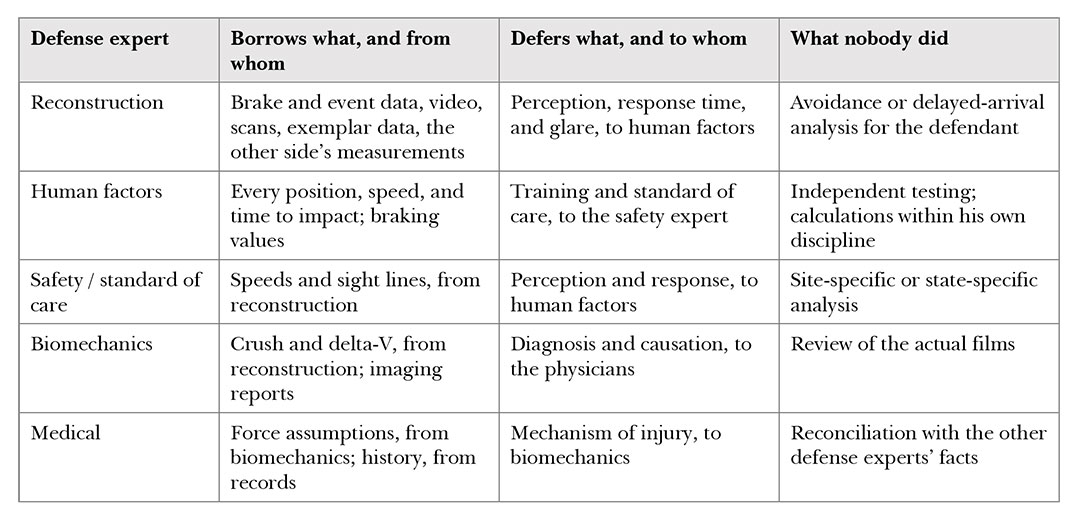
In a technically complicated case, the defense divides the work. The reconstructionist determines positions, speeds, distances, and timing. The human-factors expert addresses perception, visibility, expectation, and response. The safety expert addresses training and safe operation. A biomechanical engineer takes the forces established by the reconstruction and uses them to discuss injury mechanisms. Physicians address diagnosis and medical causation. Each expert has a lane, and that division of labor makes perfect sense.
It is also useful to the defense because whenever you cross the line between disciplines, the answer becomes predictable: “I would defer to the reconstructionist.” “I would defer to human factors.” “That is really a medical question.” If you take each deposition in isolation, those answers can be frustrating. If you take the depositions as pieces of a single expert case, those same answers become the roadmap.
In the trucking-versus-auto case, I asked the human-factors expert who had performed the speed, distance, and time calculations he was using. He explained that the reconstruction experts had performed the underlying calculations and simulations and then said the words that ultimately gave this article its title: “My analyses sit on their shoulders.”
That matters because if the human-factors expert’s opinions sit on the reconstructionist’s shoulders, he cannot simply abandon the reconstruction when it becomes inconvenient. If the reconstruction establishes a position, speed, sight line, or point in time, that fact becomes part of the foundation supporting the downstream opinion. Conversely, if the reconstructionist did not perform an analysis, find out who did. If the human-factors expert says the issue belongs to reconstruction and the reconstructionist says he did not do it, you may have found an unanswered question in the defense case. If two experts defer to one another on the same issue, you may have found something even better: a question nobody on the defense side intends to answer. That is the seam, and seams are where complicated expert cases come apart.
Map the expert case before taking the first deposition
Most of us know the traditional way to prepare an expert deposition: read the file, review the CV, understand the opinions, research the literature, review the invoices, identify prior testimony and potential bias, and prepare the outline. Do all of that, but before preparing expert by expert, take one pass through the entire defense expert case.
Start with the designations and read them against each other, not one at a time. California’s expert-disclosure statute requires a brief narrative statement of the general substance of the expected testimony and a representation that the expert will be sufficiently familiar with the case to provide a meaningful deposition. (Code Civ. Proc., § 2034.260, subd. (c).) Where do the descriptions overlap? Where are the gaps? Those intersections tell you where to start looking.
Next, look for opinions the experts gave earlier in the case. Summary-judgment declarations give you a dated snapshot. In that same case, the defense reconstructionist’s earlier declaration placed the truck’s impact speed in one range, while his later analysis used a different number. Technical work develops and calculations get refined, but if an opinion changed, I want to know what changed it.
Then get into the expert files and look for the work of other experts. Who has whose report? Who has whose slides? Who is relying on someone else’s measurements? The human-factors expert had the reconstruction work, and the reconstructionist himself testified that there was an area of overlap between reconstruction and human factors involving available sight lines and fields of view.
Review invoices and correspondence as well. A billing entry for a “technical discussion” may reveal that two experts have been talking. Ask who spoke with whom, what they discussed, and what documents or calculations were exchanged.
Native files beat PDFs
Finally, get the native files whenever possible. A PDF of a PowerPoint is not the same thing as the PowerPoint; videos, animations, and embedded information disappear. If the expert created a simulation, model, spreadsheet, or presentation, I want the working version. Then start looking for the seams: borrowed assumptions, issues everyone relies upon but nobody owns, direct contradictions, analyses nobody performed, or alternative scenarios the defense wants to preserve simultaneously.
The labels are not important. Ask yourself: What does this expert need to be true for his opinion to work, and who gave him that fact? Then go talk to that person.
Trace every number, then find the work nobody did
One of the easiest ways to understand a complicated technical opinion is to ask where every number came from. Experts routinely use information developed by someone else, and there is nothing inherently improper about that. The important question is which parts of the opinion belong to the witness and which were borrowed.
In the trucking-versus-auto case, the human-factors expert used time-and-distance calculations incorporating values he had not independently developed. Once you identify a borrowed input, trace it backward. Did the upstream expert calculate, test, or measure it? Was it assumed or supplied by counsel? Did it come from your own expert? The source may tell you more about the opinion than another 20 questions about the final calculation.
Sometimes the problem is the opposite: work nobody did. The reconstructionist explained that his physics-based simulation was not designed to replicate exact lighting conditions or glare. Human factors was the natural place for that issue to go, but if that expert cannot scientifically reconstruct the actual glare conditions either, the defense theme may sound far more certain than the expert record actually is.
Training created a similar issue. The trucking expert would defer perception issues to human factors, while the human-factors expert would defer training issues to the trucking expert. If your case depends on what a trained commercial driver should be doing while approaching an intersection, follow that issue through both depositions. Do not let it disappear in the handoff. One expert may legitimately say a question is outside his discipline, and the next expert may legitimately say it is outside his. But by the time you have finished taking both depositions, you need to know whether anyone on the defense side actually did the analysis.
Let the expert teach you
There is another part of my approach to technical depositions that may sound counterintuitive: I tell experts when I do not understand something. I do not pretend to be an engineer or a human-factors expert because I spent three nights reading a file. If I do not understand something, I ask.
In one human-factors deposition, when the expert did not understand where I was going with a question, I told him, “This isn’t my field, so I was trying to learn your field in the last couple of days.” In another portion of the deposition, a discussion of peripheral vision became genuinely interesting, so I stopped and asked him more about the underlying research. There is nothing wrong with admitting that you do not understand something. Experts generally like talking about their work, and letting them explain can be productive.
A relaxed expert gives you the terminology, tells you which assumptions matter, identifies the limits of the methodology, and often tells you where another discipline begins. Most importantly, an expert who explains commits to his own work in plain language. That commitment may ultimately be far more valuable than an admission you could force out of him with an aggressive question.
I build my technical depositions in PowerPoint. I embed the exhibits in the order I expect to use them, enlarge important language, include screenshots of the expert’s digital file, and put the expert’s own slides into the presentation. When we reached the reconstructionist’s slides, I let him walk me through them. At one point I told him the truth: “I’m just laying foundation. I’m not trying to trick you. I’m not smart enough in your area.”
He explained his work in detail. Before I ever used his simulation against another expert, I wanted the person who created it to explain why it could be trusted. He described the data in the file, the scan information, the three-dimensional geometry, the simulation program, and the different output videos. He explained that the driver’s-view simulation showed what would be available for the commercial truck driver to see on approach to the intersection. I did not need to fight him on any of that. What I needed was for him to build the foundation for the very demonstrative I planned to use later against another defense expert.
Read the literature, all of it
There is no glamorous way to say this: read the studies. Not the abstract. Not the expert’s summary. Not the highlighted paragraph someone on your team pulled out. Not an AI summary, either. Actually read them.
Human-factors opinions are particularly dependent on published literature. A slide may say that “drivers do X” or “pedestrians do Y,” with a citation underneath. Find out whether the study actually says what the slide implies. Who were the subjects? How old were they? Was it daytime or nighttime, a simulator or the real world? Were the subjects warned about what was coming? Did they resemble the person in your case? Most importantly, what did the study actually measure?
I have taken two depositions of the same human-factors expert in very different cases. In both, the literature became some of the most productive material in the examination. In the sidewalk case, the expert used published research to estimate how quickly an elderly pedestrian would walk and what her step length would be. He explained that one equation used age, height, and weight to estimate step size and walking speed. I asked whether the equation took into account an individual’s health problems or gait abnormalities. “It’s a generalization.” Did he know how fast this particular pedestrian actually walked? No. Did he know what her gait looked like, whether she shuffled her feet or took longer steps? No. He was not there.
That does not make the study junk science. The point is to define precisely what the science can tell the jury and what it cannot. A study involving healthy subjects walking across a flat surface may be informative, but a controlled laboratory floor is not a broken city sidewalk, and a study population decades younger than your plaintiff is not your plaintiff.
Sometimes the expert’s own data is better for you than the conclusion on his slide. In the sidewalk case, a slide stated that pedestrians fixate on path irregularities, but the underlying study showed a far more modest percentage of fixations on cracks. Another obstacle-clearance study included older participants who contacted the obstacle even under controlled circumstances after being warned it was there. Those details disappear if you stop at the abstract.
One more question matters when reviewing the literature: What is this study actually about?
When good science answers the wrong question
The human-factors expert in the trucking-versus-auto case relied heavily on gap-acceptance literature. Gap acceptance examines how a driver on a minor road judges whether there is enough time to pull into or cross a major roadway before an approaching vehicle arrives. That literature was relevant because the driver of the passenger vehicle was entering the highway, and the defense wanted to establish that she accepted a gap a reasonable driver would not have accepted.
But after reading the literature, another question became obvious: What did any of these studies say about the approaching tractor-trailer driver? Did the gap-acceptance literature say that the approaching driver was relieved of the obligation to maintain a proper lookout? Did it say anything about responding to a flashing warning sign? Did it establish that a driver on the major road should maintain or increase speed because the entering driver accepted a poor gap?
The expert acknowledged that the gap-acceptance studies generally did not address the other driver’s conduct. He had seen nothing in that literature excusing another driver from maintaining a proper lookout, and slowing at intersections was beyond the scope of the literature he was relying upon. His library was focused on the driver entering the highway. It had very little to say about the man driving the tractor-trailer.
That is a much better deposition point than simply accusing an expert of relying on bad science. The science may be perfectly valid. It simply may not answer the question the defense wants the jury to think it answers. There is a significant difference between attacking the reliability of a study and demonstrating that a reliable study does not support the proposition for which the defense is trying to use it.
Sequence the depositions so one feeds the next
If Expert B depends on Expert A, take Expert A first whenever you can. Think upstream and downstream. Reconstruction before human factors. Imaging and treating physicians before biomechanics when the biomechanical opinion relies on medical findings. The objective is to walk into each downstream deposition carrying testimony from the person whose work sits underneath it.
I wanted the reconstructionist before the human-factors expert because the reconstructionist created the geometry and timing that human factors would use. I wanted his testimony before questioning anyone about what those positions meant from a perception standpoint. Get a rough transcript quickly, and if there is testimony you know you will need in the next deposition, obtain a certified excerpt if possible and mark it as an exhibit. Do not rely on your memory of what the first expert said. Put the first expert’s actual words in front of the second expert.
This becomes particularly effective when nobody wants to own an analysis. Our reconstruction expert had concluded that slowing the tractor-trailer would have delayed its arrival at the intersection enough to avoid the collision. The defense reconstructionist had not performed that same delayed-arrival analysis. I took that testimony into the human-factors deposition and asked whether he intended to offer an opinion that slowing would or would not have avoided the collision. He did not. I then asked whether he was going to determine whether the truck should have slowed based upon the conditions in the intersection. He would leave that to the reconstructionist.
Except I had already deposed the reconstructionist, and he had already told me he had not done that analysis. Taken separately, both answers sound like appropriate limitations on an expert’s scope. Put together, they mean the defense is going into trial without an expert calculation answering one of your central avoidance opinions.
Do not automatically attack their demonstratives
This may be my favorite lesson from the trucking-versus-auto case. The defense reconstructionist created a sophisticated three-dimensional simulation showing the collision from several perspectives, including a bird’s-eye view, the passenger-car driver’s point of view, and the view from inside the tractor-trailer. The defense theory was that a pickup truck turning through the intersection obstructed the truck driver’s view, and the simulation was built, at least in part, to illustrate that obstruction.
I watched those videos more times than I can count. At some point, I stopped watching them as defense demonstratives and started reading them as data. The defense had spent a considerable amount of time and money developing a time-stamped, three-dimensional reconstruction of the intersection, the vehicles, their positions, their movement, and the truck driver’s viewpoint. Then they gave it to me.
My liability question was simple: What could the truck driver see, and when could he see it? To answer that question, I used the simulation from his seat, not the bird’s-eye view and not the passenger-car driver’s view. I pulled still frames at meaningful intervals and tied them to events the defense reconstructionist had already identified. When did the warning sign become visible? Where was the pickup? When did the passenger car begin moving? What was the truck’s speed? When did the truck pass the warning sign?
I labeled everything consistently: the warning sign blue, the pickup green, the passenger vehicle red, and another vehicle a fourth color. Be methodical. One flattering screenshot can be dismissed as an isolated instant; a consistent, transparent sequence becomes evidence.
Before showing the first frame, I established that the human-factors expert had reviewed and relied upon the reconstruction. Then we walked through it. At 10 seconds before impact, nothing stood between the truck and the flashing warning sign. At 6.8 seconds, the sign and pickup were visible. At 5.7 seconds, the warning sign, pickup, and passenger vehicle were all visible. At about five seconds, the pickup was in the truck’s lane and the passenger vehicle remained visible.
Then I reached 4.7 seconds. I asked, “And at least from this simulation at 4.7 seconds prior to impact, there is nothing blocking the sight line of either the pickup truck or [the passenger vehicle]. Would you agree with that?” The expert answered, “There is nothing blocking the sight line at this moment in time.” We kept going. At 4.03 seconds, there was a sight line to both vehicles. At 3.47 seconds, the sight lines remained unobstructed. At 2.63 seconds, another vehicle had arrived at the intersection, and the defense simulation continued to show what was visible from the truck driver’s perspective.
Eventually, the human-factors expert tried to expand one of my sight-line questions into what the passenger vehicle was doing and how slowly it was moving. I stopped him and asked, “Why was it important for you to add that when I did not ask what her speed was?” He explained that what the object was doing was relevant to how it functioned as a stimulus. Fair enough, but that was not my question. I was asking about sight line, and after I redirected him, he agreed there was a sight line.
Know where the expert will retreat
A good expert is not going to abandon an ultimate opinion because you showed him an inconvenient frame. He will retreat to the limits of his science, and he should. Expect three retreats, and know exactly what each one gives up and what it does not.
The first retreat is that an unobstructed sight line does not necessarily mean the driver perceived the object. That is correct. Sight line and perception are different questions. The reconstruction establishes what was physically available to be seen, where the vehicles were, and when those conditions existed. Human factors addresses the separate question of whether a driver would actually perceive and respond to those stimuli. I did not need the human-factors expert to admit that the truck driver actually saw the passenger vehicle. I needed him to agree with what the defense reconstruction showed: for several seconds there was an unobstructed sight line to the warning sign, the pickup truck, and the passenger vehicle. Once that testimony was locked in, I could move on to perception without confusing the two issues.
The second retreat is conspicuity. The collision occurred at night, so the expert could argue that the passenger vehicle did not stand out sufficiently against the environment. Instead of overreaching, I focused on what that explanation did not account for: a flashing warning sign before the intersection, a full-size pickup moving through the roadway, and another commercial driver who saw the warning sign and slowed. The question was not whether darkness mattered. It was whether the expert’s explanation accounted for the entire scene or only the stimulus most helpful to the defense.
The third retreat is expectation. The expert’s opinion was that the passenger vehicle, moving slowly from the stop sign, may not have looked like a vehicle about to enter the highway, so a typical driver would not necessarily respond simply because it was visible. I accepted that premise long enough to see where it led. The simulation also showed the pickup and the warning sign, and while those conditions developed ahead of the tractor-trailer, the speed shown in the reconstruction increased. When I asked what study supported a typical driver maintaining or increasing speed with a vehicle in the roadway ahead, he could identify none at that moment.
The literature and the reconstruction had intersected. The lesson is to know exactly what each piece of testimony proves and to use it for that purpose. The frames established opportunity and the physical scene; the human-factors testimony addressed perception and response. Together, they were far more useful than forcing either discipline to say something it could not support.
Close the doors before you leave
After several hours of technical testimony, there is a temptation to get to the end and simply stop. Resist it. The last few questions in an expert deposition can become some of the most important ones you ask. Confirm that you have covered every opinion the expert intends to offer at trial, every calculation, analysis, simulation, and publication the expert intends to rely upon, and whether the expert anticipates doing any additional work before trial.
California law gives those questions teeth. When an expert testifies to specific opinions and affirmatively states those are the only opinions he intends to offer at trial, later expansion may be excluded as unfair and prejudicial. (Jones v. Moore (2000) 80 Cal.App.4th 557, 565; see Bonds v. Roy (1999) 20 Cal.4th 140, 146–147; Kennemur v. State of California (1982) 133 Cal.App.3d 907, 919.) I want the record unmistakable about what the expert is, and is not, going to say.
Watch what happens during breaks, too. In the trucking-safety expert’s deposition, I confirmed he had given me all of his opinions. After a break, he returned with a new opinion about the passenger-car driver’s training. I asked whether he had spoken with defense counsel and then established what evidence supported the new opinion. An expert can refine an answer, but make a record of when the opinion appeared, what supports it, and what happened before it changed.
What you should walk out with
A good technical-expert deposition should leave you with more than a transcript. It should leave you with testimony you can use: admissions that are difficult to retreat from without contradicting another defense expert, or a demonstrative the defense created and authenticated that now illustrates your theory better than theirs.
Sometimes it means a motion in limine. If an expert has expressly declined to perform an analysis, you have a basis to argue against a new version appearing for the first time before the jury. If an expert is reaching across disciplines and performing another expert’s work with borrowed assumptions, that may warrant scrutiny under the court’s gatekeeping role. (See Sargon Enterprises, Inc. v. University of Southern California (2012) 55 Cal.4th 747.) If an expert has relied on published material, that literature may become fertile ground for cross-examination under Evidence Code section 721, subdivision (b).
Sometimes what you walk out with is your closing argument. In this case, an important point did not reveal itself until trial preparation, when we read the transcripts side by side. The defense reconstructionist had criticized our assumption about the distance of a warning sign, yet the number came from the defense’s own summary judgment materials. Another part of the reconstruction placed a vehicle traveling through the intersection at a speed remarkably close to our expert’s avoidance threshold. Neither point looked dramatic alone. Together with the rest of the expert record, they mattered.
Some seams are obvious while you are taking the deposition. Others only appear after you put all of the testimony next to each other. Build in the time to do that. The case resolved shortly before trial. By that point, the defense was not evaluating it based solely on what our experts were going to say. It had to evaluate the case knowing what its own experts had already given us.
I still can’t do math
I still cannot do math. Fortunately, I never needed to. Their reconstructionist did the math, their human-factors expert confirmed the sight lines frame by frame, their trucking-safety expert supplied the safety principles, and their literature defined the limits of the scientific opinions. My job was to understand how those pieces fit together and make sure the experts committed to them.
The best expert deposition is not always the one where you destroy the expert sitting across from you. Sometimes the most valuable thing you can do is let that expert teach you exactly how to take apart the next one.
Lourdes De Armas is a partner and lead trial attorney at Omega Law Group. Her trial practice focuses on claims for catastrophic personal injury, premises liability, sexual abuse, and wrongful death Lourdes is a member of the Los Angeles chapter of the American Board of Trial Advocates (“ABOTA”), where she serves on the Executive Committee.
Lourdes De Armas

Lourdes De Armas is a partner and lead trial attorney at Omega Law Group. Her trial practice focuses on claims for catastrophic personal injury, premises liability, sexual abuse, and wrongful death Lourdes is a member of the Los Angeles chapter of the American Board of Trial Advocates (“ABOTA”), where she serves on the Executive Committee.
Copyright ©
2026
by the author.
For reprint permission, contact the publisher: Advocate Magazine