
International mediation
Redefining and reshaping litigation around the world
Increasingly around the world, mediation is no longer optional. It is a judicial imperative. It is flourishing worldwide. Even The Hague has a mediation program (Permanent Court of Arbitration, 2024). Each year, tens of millions of new civil cases are filed in the United States, with well over 100 million additional filings worldwide (National Center for State Courts (NCSC), 2023; U.S. Courts, 2024; National Judicial Data Grid, 2024). In Los Angeles County alone, more than 300,000 new civil cases are filed annually (Los Angeles Superior Court Annual Report, 2023).
Looking past our borders
Mediation has perhaps become the most recognized alternative to judicial trials worldwide. It promotes peacemaking and enhances access to justice. Mediation programs across the globe reduce court congestion and can significantly reduce the costs and burdens associated with traditional litigation. (Menkel-Meadow, “Dispute Resolution: Beyond the Adversarial Model,” 2016; ABA Section of Dispute Resolution Report, 2022; International Journal of Law in Context, 2020.)
In the United States, with few exceptions, mediation is just one option available for resolving disputes. Parties can reject it out of hand, go through court-ordered mediation and consider settling, or reach an impasse during private mediation and still end up in court.
In contrast, mandatory or quasi-mandatory mediation is the rule in multiple countries. It is an integral function of justice, not merely an optional adjunct to litigation. In most countries, mediation is not a requirement, yet it is deeply embedded and integrated into their civil justice and legal systems. (CPLJ, 2023; Legal Studies, 2022; Mandatory Mediation Study, 2023.)
Across the globe, mediation is an essential part of legal systems. Some countries have perfected it over decades; others are just getting up to speed. Some systems favor a hands-on evaluative approach; others prefer that mediators act primarily as facilitators. In many countries, mediators are subject to regulation and government oversight; agreements reached in mediation are judicially enforceable. (Legal Studies, 2022; International Commercial Mediation, 2019; UNCITRAL, 2019; CPLJ, 2023.)
U.S. jurisdictions can strengthen their justice systems by looking beyond national borders. In a globalized world – where those engaged in science, technology, manufacturing, and the arts freely exchange ideas – the American legal system should likewise learn from the successes and failures of mediation programs worldwide.
Europe
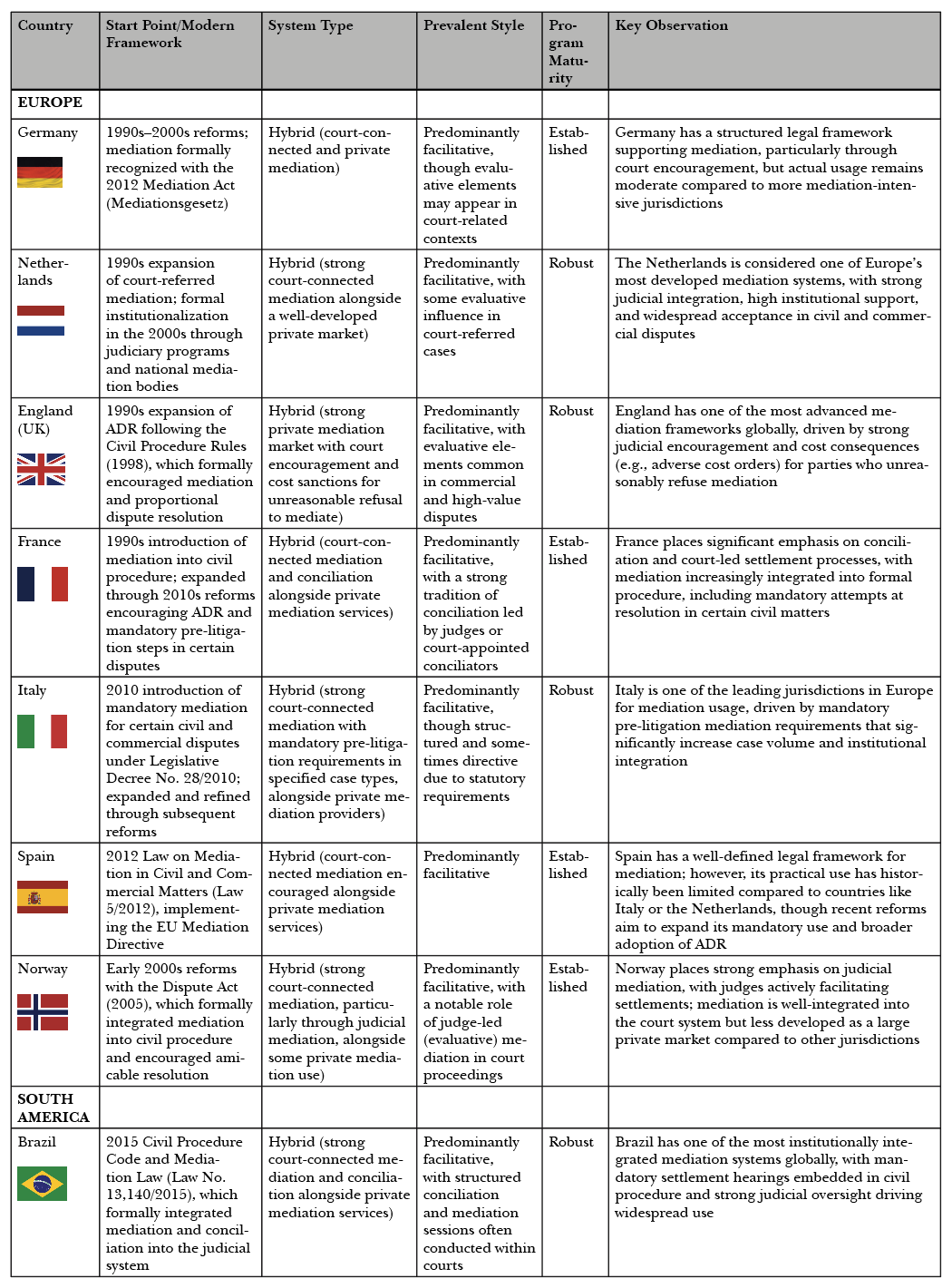
European legal systems reflect the full spectrum of mediation practices. At one end are jurisdictions that rely primarily on voluntary mediation, supported by judicial encouragement. In the middle are jurisdictions that have adopted a hybrid approach. At the other end are jurisdictions that have embedded mandatory mediation directly into their judicial frameworks. (European Parliament, 2018.)
Among countries with voluntary systems are Germany and the Netherlands. (EU Mediation Directive 2008/52/EC Implementation Reports.) In Germany, mediation is strongly encouraged, but not mandated. Courts actively promote mediation and may refer cases to court-annexed conciliation judges, but parties are not required to settle. Limited sanctions exist for failure to appear once a court has ordered a conciliation hearing, reflecting procedural cooperation rather than substantive compulsion. (German Code of Civil Procedure (ZPO) § 278 et seq.)
Although mediation is voluntary in the Netherlands (European e-Justice Portal), the country’s strong legal culture promotes mediation. It is encouraged by judges and through enforceable contractual mediation clauses with cost consequences for non-cooperation. (De Roo & Jagtenberg, 2017.) Courts view mediation as a legitimate extension of pre-trial dispute management rather than an alternative system. Despite the lack of strict regulation, mediation has integrated seamlessly into existing conflict-handling structures, contributing to early adoption and high success rates.
The High Court of Ireland has held that, in appropriate cases, parties can be ordered to mediation as part of a court’s inherent jurisdiction. (J Burke & Associates v.O’Connell (2026) IEHC 314.) For further reading, see Phillip Lee, “Court-Ordered Mediation in Ireland: High Court Affirms Power to Direct Mediation,” May 27, 2026, American Arbitration Association.
Hybrid jurisdictions include England and France. Although mediation is not mandatory in the UK, the country has undergone a decisive shift toward mandatory and quasi-mandatory mediation, driven primarily by judicial policy rather than by legislation. Courts may impose cost sanctions for unreasonable refusal to mediate (Halsey v. Milton Keynes NHS Trust (2004) EWCA Civ 576), and recent reforms require mediation in small claims disputes under £10,000. (UK Civil Procedure Rules, 2024 amendments; UK Ministry of Justice.)
France mandates mediation or conciliation for smaller disputes under €5,000 and certain neighborhood conflicts. (French Code of Civil Procedure, Art. 750-1.) Judges encourage parties to take the most suitable avenue for resolving their dispute. They may, at any time, order the parties to participate in mediation or conciliation to ensure they are aware of extrajudicial dispute resolution options. (Decree 2025-660.)
Mediation is mandatory in Italy, Spain, and Norway, in many areas of the law. (European e-Justice Portal.) Norway requires mediation for certain civil disputes, including claims under 200,000 NOK. (Norwegian Dispute Act, Section 6-2.) Spain responded to judicial congestion, long case duration, and declining public trust in the justice system by adopting far-reaching mandatory mediation reforms explicitly designed to reposition courts as a last resort. Since 2025, mediation or another ADR method has become a procedural requirement for most Spanish civil proceedings. (Osborne Clarke; Chambers and Partners.)
Italy may be considered the gold standard for mediation, with one of the most robust mandatory mediation systems in the world. (Italian Legislative Decree No. 28/2010; European e-Justice Portal.) In Italy, mediation is a condition precedent to litigation. (Italian Legislative Decree No. 28/2010.) Approximately 200,000 Italian lawsuits are directed annually into mandatory mediation across subject areas, including real property, inheritance, landlord-tenant, condominium disputes, medical malpractice, and commercial contracts. (Italian Ministry of Justice Statistics, 2023; European e-Justice Portal.) Approximately 15% of these cases – roughly 30,000 – settled in 2022 without litigation. (De Palo & Trevor, EU Mediation Study, 2014; updated Italian Ministry data, 2023; Matteucci, 2025.)
South America
As in Europe, South American mediation runs the gamut from voluntary to mandatory. Brazil’s system is hybrid, but closely integrated into its civil procedure. Parties are strongly nudged toward mediation through mandatory early hearings and may face cost consequences for non-participation. (Mediare.) Mediated settlements are legally binding and enforceable, especially when judicially confirmed. Despite these procedural incentives, mediation in Brazil is largely concentrated in high-value commercial disputes and in major urban centers. (Law Nos. 13,105/2015 and 13,140/2015.)
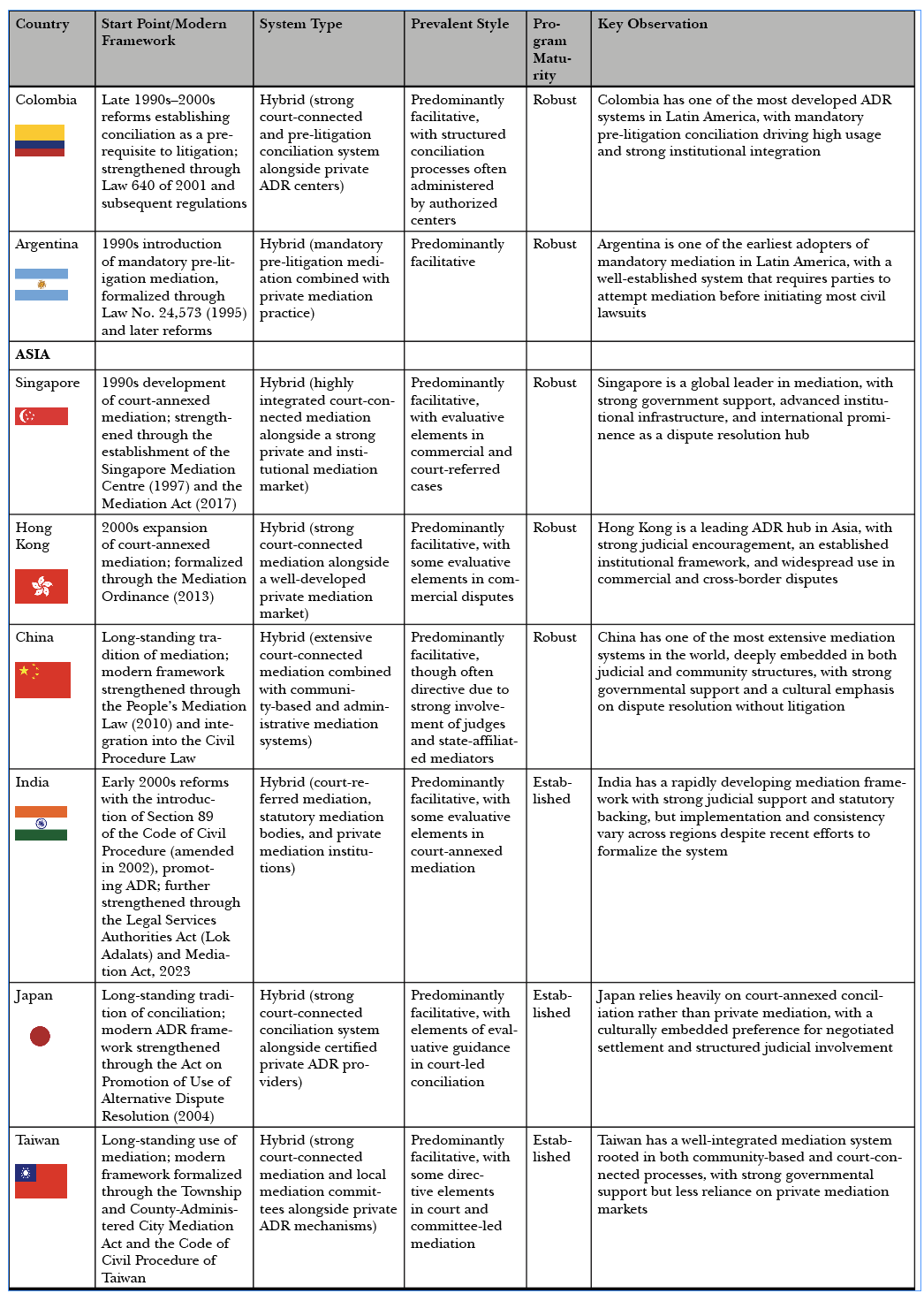
Colombia adopted the Conciliation Statute in 2022. This law is intended to strengthen conciliation as a core justice mechanism rather than an auxiliary tool. Conciliation is often mandatory as a precondition to litigation, particularly in civil, administrative, family, and labor matters. (Colom. Law 640 of 2001, art. 35.) Accredited conciliators operate within authorized centers, and the Ministry of Justice closely supervises the system. Agreements reached through conciliation have direct enforceability, equivalent to judicial decisions.
Argentina has a compulsory and enforcement-oriented model; mediation is not an alternative to litigation but an integral part of the judicial process itself. Pre-trial mediation is a prerequisite for most civil and commercial claims, enforced through admissibility rules, attendance obligations, and financial sanctions. There are strict accreditation requirements for mediators and centralized oversight by the Ministry of Justice. Mediation agreements carry the same legal force as court judgments. (Law 26,589 art. 1, 2, 3, 4, 11, 19, 28, 30, 40.)
Asia
Asia has likewise emerged as a major force in both domestic mediation and cross-border commercial dispute resolution. Singapore is regarded as the world’s leading hub for international commercial mediation; Hong Kong is critical to mediating cross-border disputes with the People’s Republic of China; and the PRC operates within its borders one of the largest mediation systems in the world. Japan, South Korea, and India actively promote mediation by embedding the discipline into their respective court processes. (Singapore Mediation Act, 2017; Hong Kong Mediation Ordinance (Cap. 620); Code of Civil Procedure, 1908 section 89 (India); Japan Civil Conciliation Framework.)
China’s highly institutionalized mediation system operates alongside, and often in close connection with, the courts. Mediation is deeply rooted in the state’s governance tradition. It applies broadly to civil, commercial, administrative, labor, environmental, property, and small-claims disputes. (Civil Procedure Law of the People’s Republic of China (2007), Art. 3, 5, 16.) Although mediation is voluntary in most contexts, judicial encouragement is strong (Civil Procedure Law of the People’s Republic of China (2007), Art. 9), parties are often pressured to mediate in response to judges’ performance metrics and heavy caseloads. People’s mediation committees play a central role at the grassroots level, emphasizing social harmony, persuasion, and education, rather than strict neutrality. (People’s Mediation Law of the People’s Republic of China, Arts. 1, 2, 16.) Judicial mediation agreements, in contrast, are formalized by the court and carry the same effect as judgments.
In 2023, India embedded mediation as a compulsory gateway to litigation through the Mediation Act. This reflects a policy-driven effort to tackle chronic judicial backlogs and democratize access to justice by normalizing early settlement. The country invested heavily in standardization, accreditation, and regulatory oversight, notably through the Mediation Council of India. (Mediation Act, 2023, Statement of Objections and Reasons, § 5-8 and 31-40.) Still, early empirical evidence shows a significant implementation gap, with high levels of non-participation, procedural delay, and limited settlement outcomes, particularly in commercial courts. This suggests that compulsion alone may not foster meaningful engagement, absent cultural acceptance, incentives, and institutional capacity. (NITI Aayog, Strengthening ADR in India, 2021.)
Japan’s mediation system is court-centered and procedurally disciplined, governed primarily by the Civil Conciliation Act. Mediation is mandatory before litigation in certain disputes, notably rent adjustment and divorce cases. Courts also retain broad discretion to refer disputes to mediation at any stage of proceedings. (Civil Conciliation Act of Japan, Art. 24.)
Taiwan operates a hybrid mediation system that integrates mandatory, voluntary, judicial, and local (town) mediation mechanisms. Mediation applies to civil, commercial, labor, consumer, family, and minor criminal disputes, with mandatory pre-trial mediation required for a defined set of cases under the Code of Civil Procedure, including lower-value claims and certain commercial and family matters. Outside these categories, mediation remains voluntary, but is widely encouraged by courts. (Township Mediation Act, Arts. 1-3, 12; Code of Civil Procedure of Taiwan Art. 377, 403 et seq.)
Family law mediations, internationally
Family law is the area for which mediation is often mandated, both in the United States and internationally. Instead of enduring lengthy waits while domestic violence or child custody issues persist, parties should be able to immediately resolve their issues.
In Switzerland and Germany, mediation is the first step; court-sponsored mediation programs help families resolve their matters before incurring significant legal expenses. The UK incentivizes mediation with financial support, making it easier for families to resolve their disputes without ever seeing a judge. Up to 80% of these cases settle early, saving time and money.
The Hague
The Hague Conference on Private International Law (HCCH) oversees the Hague Convention Mediation Program, which is focused on abduction access cases, primarily issues related to future time-sharing parenting schedules. It does not address child support or immigration issues.
Mediation services are also available in Hague Abduction Convention return cases, which focus on the return of a child. Mediation might also be used to mediate non-Hague international parental child abduction cases, and it might include a parenting coordinator trained in psychology and child development. The HCCH Guide to Good Practice for family cases emphasizes fast, child-focused solutions.
Although mediation can be successful in resolving most divorce and custody cases, the success rate in Hague Convention custody cases is only about 5%, due to the highly contentious nature of these cases. They tend to be highly charged, with urgent claims of abduction or wrongful retention. Judges may order mediation to encourage settlement, but parents in Hague disputes are rarely able to reach an agreement when their conflict has escalated.
Parents seeking relief under the Hague Abduction Convention can choose mediation while also filing a Hague petition in court. If they pursue mediation but do not reach an agreement, they can still seek a court decision to resolve their dispute. Ultimately, the HCCH has little control over how each of its signatory countries maintains, updates, and delivers justice.
Conclusion
Countries worldwide are experimenting with mandatory mediation, both pre-filing and pre-trial. When required before filing suit, many disputes are resolved quickly and inexpensively. In the United States, however, widespread adoption will require a legal and cultural shift. Courts and legislatures may support such programs, but until the bar and public grasp their benefits, acceptance will be slow.
Global experience shows that the most effective programs are those that are culturally integrated over time. (European Commission, Rebooting the Mediation Directive, COM (2018) 40 Final.) India’s attempt to implement mandatory mediation rapidly highlights the gap between legislative ambition and real-world behavior: Success depends on sustained incentives, public awareness, cultural acceptance, and enforcement. (NITI Aayog, Designing the Future of Dispute Resolution: The ODR Policy Plan for India 2-3, 60-63 (2021.)
South Africa’s decade of mandatory mediation offers a similar lesson. It is not a cure-all, but a strategic tool – expanding access to justice, reducing inefficiencies and costs, and encouraging collaboration. Long-term success relies on strong infrastructure, well-trained mediators, stakeholder buy-in, and a legal culture that values resolution over litigation. (Uniform Rules of Court Rule 41A; Department of Justice and Constitutional Development, Court-Annexed Mediation Program.)
Worldwide, mediation is no longer peripheral – it has become a central pillar of modern justice systems.
Attorney Robert M. Cohen is a neutral with Alternative Resolution Centers (ARC), where he handles a wide range of cases, including personal injury, habitability, HOA, business disputes, and real estate matters. Over the course of a four-decade legal career, Mr. Cohen has been involved in over thousands of litigated matters of all types and participated in over 1,000 mediations. 310-553-0060; This email address is being protected from spambots. You need JavaScript enabled to view it.
Robert Cohen

Attorney Robert M. Cohen is a neutral with Alternative Resolution Centers (ARC), where he handles a wide range of cases, including personal injury, habitability, HOA, business disputes, and real estate matters. Over the course of a four-decade legal career, Mr. Cohen has been involved in over thousands of litigated matters of all types and participated in over 1,000 mediations. 310-553-0060; rmcohen@rmcohenlaw.com
Copyright ©
2026
by the author.
For reprint permission, contact the publisher: Advocate Magazine